
“How AI Is Transforming Our Life in 2026: Trends, Risks & What’s Next”
AI in Everyday Life 2026: From Smart Assistants to Ambient Intelligence”
AI’s shift in 2026 isn’t about flashy demos anymore — it’s becoming infrastructure, quietly running underneath the apps people already use.
What’s actually happening
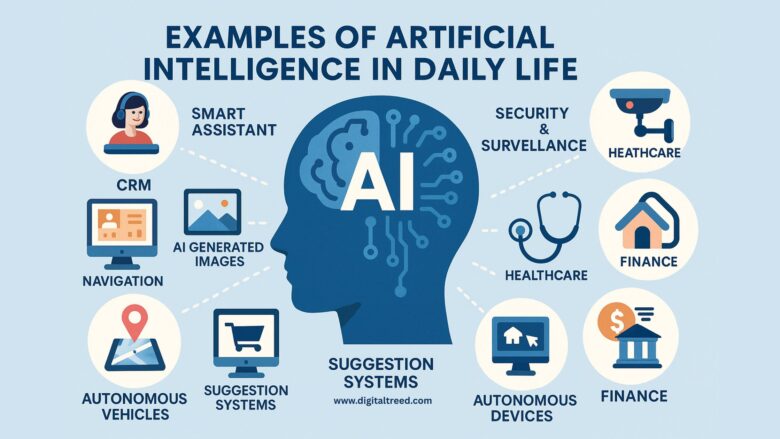
The biggest theme this year is that AI has moved from something people occasionally open a chatbot for, to something operating in the background of ordinary tools. By 2026, AI runs beneath search, maps, health apps and work tools, reshaping daily life even for people who never open a chatbot, with edge AI running models directly on devices to reduce latency and improve privacy. Smartwatches now process health signals locally, cars detect hazards and adjust routes without constantly pinging the cloud, and factory sensors flag anomalies on the fly. YoopyaYoopya
Major platforms reflect this shift toward “ambient” AI. Google’s recent updates center on an “agentic” era built around the Gemini 3.5 model, with the Gemini app evolving into a proactive assistant that manages inboxes, schedules appointments, and anticipates daily needs rather than just answering questions. Microsoft frames 2026 similarly, describing it as the year AI evolves from instrument to partner — moving beyond answering questions to actively collaborating with people in medicine, software development, and scientific research. GoogleMicrosoft News
Where the impact is most visible
Work and productivity: AI-powered assistants now schedule meetings, summarize documents, draft emails, and organize tasks automatically, with companies also using AI to automate repetitive work and improve customer service through chatbots. Lodpost
Commerce: AI agents are evolving from passive recommendation engines into autonomous personal shoppers that can research options and complete purchases on a user’s behalf, letting people simply describe what they want instead of manually searching. Built In
Health and wearables: Google’s health push includes a $10 million initiative across five universities applying quantum science and AI to life sciences, alongside new consumer wellness hardware. Google
Science: AI is beginning to actively join scientific discovery itself — generating hypotheses and running parts of experiments — building on how it already works alongside developers in “pair programming” and automates everyday tasks like shopping and scheduling. Microsoft News
The friction underneath the convenience
This isn’t a frictionless story. Despite AI’s usefulness, more than half of Americans use it daily, yet a majority also believe it poses serious risks to society — a tension between convenience and unease that defines the current moment. Researchers also flag a subtler risk: as synthetic, AI-generated media becomes more convincing, the challenge is shifting toward maintaining a shared sense of reality. Regulators are responding in kind — the EU AI Act reaches full implementation by August 2026, setting a global benchmark for how high-risk AI systems must behave in the real world, with regulatory focus shifting from how models are trained to how they act once deployed. Yoopya + 2
Conclusion
The defining shift of 2026 isn’t a single breakthrough product — it’s that AI has stopped being a destination (a chatbot you visit) and become a layer running underneath transportation, health, work, and commerce. That brings real convenience, but it also makes AI’s influence harder to scrutinize precisely because it’s invisible by design. The open questions for the rest of the year are less about what AI can do and more about who gets to see how it’s deciding things on our behalf, and how accountable that quiet infrastructure remains as it spreads further into daily routines.