
Fractured Frames: How Post-Structuralist Cinema Redefined Global and Indian Auteur Filmmaking After the 1980s
(From Pasolini to Lynch: Tracing Post-Structuralist Theory Across World and Indian Cinema)
Introduction: When the Author Died on Screen- Post-structuralism entered film theory as a challenge to the very idea of a stable, coherent text. If Barthes declared the “death of the author” and Derrida taught us to distrust fixed meaning, cinema after the 1980s began to embody these ideas on screen rather than merely discussing them in seminar rooms. Narrative stopped pretending to be a window onto reality and started admitting it was a construction – assembled, editable, unreliable, and endlessly open to reinterpretation.
This piece traces how that sensibility moved from arthouse theory into global mainstream form: fragmented chronology, unreliable narrators, self-aware texts, dissolved authorship, and cinema that interrogates its own image-making. It closes with how Indian cinema, often read only through realist or melodramatic lenses, developed its own vigorous post-structuralist strain.
What “Post-Structuralist Cinema” Actually Means on Screen
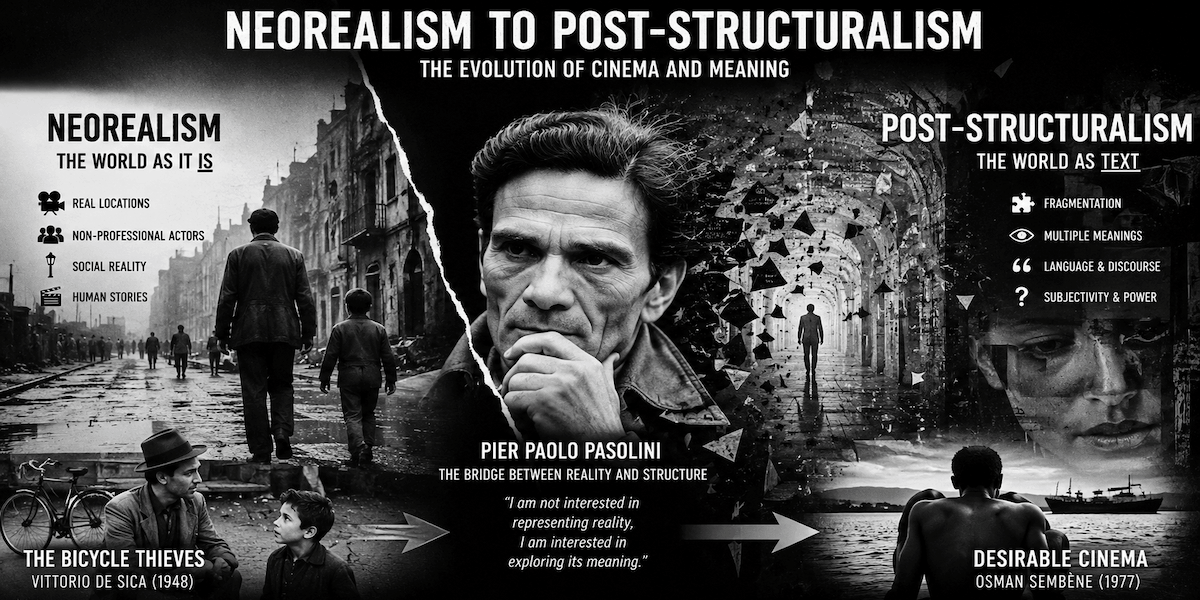
AI Image of Post Structuralism and Neo Realism
Before naming directors, it helps to isolate the formal signatures that separate this cinema from ordinary experimental or arthouse work:
- Fragmented, non-linear temporality that refuses a single authoritative timeline
- Unreliable or multiple narrators, where truth is contingent on perspective
- Self-reflexivity – films aware of themselves as films, addressing their own construction
- Intertextuality – genre pastiche, quotation, and collage of prior texts
- Decentered or dissolved identity, where character coherence itself breaks down
- Spectator implication – the audience is made complicit rather than passive
Pasolini and Derrida: Reading a Filmmaker Through Deconstruction
Pasolini died in 1975, just as Derrida’s early work (Of Grammatology, Writing and Difference, both 1967) was beginning to circulate – the two were contemporaries rather than influence and disciple. But reading Pasolini’s cinema through Derridean deconstruction reveals how closely his practice anticipated, and in places directly overlapped, post-structuralist theory.
Logocentrism and the sacred image. Derrida’s critique of “logocentrism” – Western thought’s assumption that meaning has a stable, present origin (God, reason, the self) — maps directly onto Pasolini’s strategy in The Gospel According to St. Matthew. By filming Christ using only scripture as dialogue but staging him as a political revolutionary among peasants, Pasolini refuses to let the “origin” (sacred text, institutional Church authority) fix a single stable meaning. The gospel becomes a text to be reinterpreted and redeployed, not a closed source of truth — exactly the move Derrida called for against any text claiming self-evident, authoritative origin.
Différance and the sacred/profane collision. Derrida’s concept of différance – meaning as endlessly deferred, produced through difference rather than fixed presence — is visible in how Pasolini stages his subproletariat subjects with Renaissance religious composition in Accattone and Mamma Roma. Neither the “sacred” framing nor the “profane” slum content settles into stable meaning alone; meaning is generated in the friction between them, deferred rather than delivered. The image never lets you rest on one register.
Deconstructing the family and metaphysics of presence. Derrida’s project targeted the metaphysical structures propping up Western institutions – the assumed natural, self-present authority of origin, father, law. Teorema’s stranger enters the bourgeois household and dismantles it from within simply by exposing that the family’s authority was never natural or self-evident, only performed and enforced. This is deconstruction as narrative event: showing a structure’s coherence was always contingent, not essential.
Pasolini’s own theoretical writing as proto-deconstruction. Pasolini’s semiotic essays, especially “The Cinema of Poetry,” treated cinema itself as a language system worth interrogating structurally – asking how film’s “free indirect subjective” camera destabilizes the boundary between author, character, and viewer. This is strikingly close to Derrida’s insistence that no text (cinematic or written) has a stable, self-identical meaning independent of its structure and the reader’s position within it.
Where they diverge. Derrida worked to dismantle metaphysical certainty largely through philosophical text; Pasolini fused the same impulse with an unshakeable, almost sacred belief in the body, the peasant, and pre-industrial culture as sites of authentic resistance – a residual essentialism Derrida’s thoroughgoing deconstruction would have pressed hard against. Pasolini’s late self-repudiation of the Trilogy of Life, admitting even peasant bodies had been absorbed into consumer spectacle, is in some ways Pasolini deconstructing his own earlier essentialism — arriving, from a different direction, at the same conclusion Derrida’s theory would predict: no origin stays uncontaminated for long.
Pasolini: Reinventing Auteur Cinema from Inside Neorealism
If Rossellini and De Sica built neorealism’s foundation, Pier Paolo Pasolini is the figure who took its raw material – the poor, the marginal, the unvarnished street – and fused it with a ferociously personal, theoretically saturated authorial voice. He didn’t abandon neorealism; he radicalized it, turning a movement about observing reality into a vehicle for open ideological confrontation. In doing so, he effectively invented a template for the political-poetic auteur that later post-structuralist filmmakers would inherit.
From documentary surface to “cinema of poetry.” Pasolini’s own essay “The Cinema of Poetry” (1965) argued for a subjective, irrational camera style layered beneath cinema’s realist surface — a direct theoretical break from neorealism’s claim to objective transparency. His films use neorealist tools (non-actors, real slums, location shooting) but bend them toward a personal, almost sacred vision, making the author’s presence impossible to erase – the opposite of neorealism’s self-effacing observational stance.
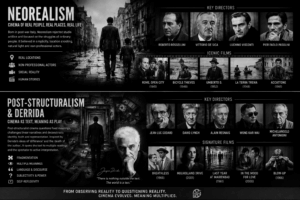
AI Image of Post Structuralism and Neo Realism
Accattone (1961) and Mamma Roma (1962). Set in Rome’s subproletariat slums with non-professional actors, these films look like orthodox neorealism on the surface. But Pasolini shoots his pimps and prostitutes with the frontal composition and gravity of Renaissance religious painting – Masaccio and Piero della Francesca are visible in every frame. This collision of gutter subject matter with sacred visual form was itself a revolt: against bourgeois cinema’s aesthetic hierarchies, against the Italian Communist Party’s discomfort with the lumpenproletariat, and against Church moralism, all at once.
The Gospel According to St. Matthew (1964). A professed Marxist atheist filming Christ’s life using only scripture as dialogue, cast entirely with peasants and non-actors. Pasolini reframed Christ as a revolutionary figure standing against establishment power – reclaiming religious material from the institutional Church and repurposing it as class critique. The film revolted against expectations from both sides: the religious establishment distrusted a Marxist director, while orthodox Marxists distrusted a film about Christ.
Teorema (1968) and Porcile (1969). Here Pasolini turns from slums to the bourgeoisie itself, using surreal allegory (a mysterious stranger who seduces and destroys an entire wealthy family) to indict capitalist domestic order as spiritually hollow. This is a direct assault on the nuclear family and private property as social structures – Pasolini using cinema as ideological weapon rather than observational document.
The Trilogy of Life (1971-74). The Decameron, The Canterbury Tales, and Arabian Nights turned to pre-capitalist, pre-industrial folk material – bawdy, communal, physically uninhibited — as a utopian counter-image to consumerist modernity. Pasolini later repudiated the trilogy himself, arguing that even peasant bodies had been co-opted and commodified by consumer capitalism, a self-critique almost unheard of from a major auteur.
Salò, or the 120 Days of Sodom (1975). His final film relocates Sade’s novel to Mussolini’s fascist Republic of Salò, staging systematic torture and degradation as an allegory for how power — fascist, capitalist, or consumerist – reduces bodies to objects of consumption. It remains one of cinema’s most direct assaults on authority as such, refusing any redemptive frame or narrative comfort whatsoever.
Global revolt, not just Italian critique. Pasolini’s target was never only Italy. He explicitly framed consumer capitalism, mass media homogenization, and the erosion of pre-industrial folk cultures as a global process – writing journalism on “the disappearance of the fireflies” to describe how television and consumerism were erasing local, embodied cultures everywhere, not just in Rome. This positioned him as an early theorist of what today would be called cultural globalization’s flattening effect, decades ahead of the term.
Why this matters for auteur cinema after him. Pasolini fused three things later auteurs would inherit separately: neorealist material, theoretical self-awareness about the author’s presence in the image, and open ideological confrontation with social structures (family, Church, capital, fascism). Directors like Haneke (institutional violence), Kashyap (co-opting genre to critique class and politics), and even Kiarostami’s collapsing of documentary/fiction boundaries all extend threads Pasolini first braided together.
From Neorealism to Post-Structuralism: An Unlikely Lineage
It seems counterintuitive to link Italian Neorealism – a movement built on the promise of unmediated truth – with post-structuralism, a philosophy that denies any such truth is accessible. But the connection is less a contradiction than a lineage, one movement quietly setting up the conditions for the other.
Shared rejection of classical transparency. Rossellini’s Rome, Open City (1945) and De Sica’s Bicycle Thieves (1948) broke with studio artifice: non-professional actors, location shooting, loose plotting, and refusals of tidy resolution. This was already an assault on cinema’s claim to seamless, invisible storytelling – the same target post-structuralist filmmakers would attack decades later, only from the opposite direction. Neorealism said “the frame can show you unvarnished reality.” Post-structuralism said “there is no frame that doesn’t construct what it shows.” Both agreed classical Hollywood continuity was a lie; they simply disagreed about what to replace it with.
Contingency over closure. Neorealist films resisted neat moral endings – Bicycle Thieves ends on an unresolved, ambiguous note rather than justice served. This refusal of narrative closure is a direct ancestor of the open, undecidable endings that define post-structuralist film: Lynch’s dissolving identities or Haneke’s unresolved Caché owe something to De Sica’s refusal to hand the audience a tidy moral.
The hinge figure: Abbas Kiarostami. No director bridges the two movements more directly. Close-Up (1990) restages a real court case using the actual people involved playing themselves, collapsing documentary and fiction into a single undecidable text — pure neorealist material processed through a fully post-structuralist lens on authorship and representation. Taste of Cherry (1997) ends by pulling back to reveal the film crew shooting the film itself, rupturing its own fictional frame exactly as neorealism once ruptured Hollywood’s.
Later inheritors. The Dardenne brothers (Rosetta, 1999; The Kid with a Bike, 2011) carry forward neorealism’s handheld intimacy and non-professional-adjacent naturalism, but their refusal to explain character motivation or supply backstory pushes their films toward the same epistemic uncertainty post-structuralist cinema trades in – we watch, but we are never granted authorial certainty about why.
In short: neorealism dismantled cinema’s classical illusion in the name of truth; post-structuralist cinema dismantled it in the name of showing that truth itself is always mediated. One is the necessary precondition for the other.
The Global Trendsetters
David Lynch – The Unconscious as Narrative Structure
Lynch’s Lost Highway (1997) and Mulholland Drive (2001) refuse to resolve into a single coherent story. Identity itself becomes fluid – characters transform into other characters mid-film, and the audience is denied any stable ground from which to judge what is “real.” This wasn’t surrealism for shock value; it was a direct staging of the post-structuralist idea that identity and meaning are never fixed, only performed.
Quentin Tarantino – Pulp Fiction and the Collapse of Chronology
Pulp Fiction (1994) rearranged its timeline into loops and detours, treating narrative sequence as an arbitrary convention rather than a natural law. Combined with its dense intertextual borrowing from B-movies, blaxploitation, and noir, Tarantino modeled cinema as a text built from other texts — precisely the intertextual weave Julia Kristeva and Barthes theorized in literature.
Wong Kar-wai – Memory, Time, and Dislocated Romance
Chungking Express (1994) and In the Mood for Love (2000) fracture time into looping, repeated gestures and voiceovers that undercut linear cause-and-effect. Wong’s Hong Kong is less a place than a mood assembled from fragments – an aesthetic that influenced global arthouse cinema’s approach to memory and desire for two decades.
Michael Haneke – Implicating the Viewer
Haneke’s Funny Games (1997) and Caché (2005) directly break the contract between screen and spectator. Characters address the camera; footage-within-footage destabilizes what counts as “the film” versus “evidence within the film.” Haneke essentially stages Derridean questions about mediation and violence, forcing the audience to confront its own position as a consumer of images.
Christopher Nolan – Memento and Subjectivized Time
Memento (2000) told its story in reverse-order fragments matching its amnesiac protagonist’s broken sense of time, making narrative structure itself an expression of unstable subjectivity — a formal device that pushed post-structuralist narrative logic into mainstream commercial cinema.
Charlie Kaufman – Authorship Eating Itself
Adaptation (2002) and Synecdoche, New York (2008) turn the act of writing and directing into the film’s actual subject, collapsing the boundary between creator and creation. Kaufman essentially dramatizes Barthes and Foucault’s “author function” debates as lived, anxious experience.
Lars von Trier – Dogville and the Exposed Apparatus
By staging Dogville (2003) on a bare soundstage with chalk outlines instead of sets, von Trier stripped away cinema’s illusionism entirely, forcing viewers to recognize the constructed nature of everything they were watching – a Brechtian move updated for a post-structuralist age.
Apichatpong Weerasethakul – Dissolving Boundaries
The Thai filmmaker’s Tropical Malady (2004) and Uncle Boonmee Who Can Recall His Past Lives (2010) blur human/animal, living/dead, and even film-genre boundaries within a single work, refusing any stable ontological frame – extending post-structuralist thought into non-Western cosmologies rather than importing it wholesale.
Indian Cinema’s Post-Structuralist Turn
Indian post-structuralist cinema is less institutionally labeled but formally rich, emerging largely outside mainstream Bollywood conventions.
Kamal Swaroop – Om-Dar-B-Dar (1988)
Often cited as Indian cinema’s first true postmodern film, Swaroop’s cult work dismantles narrative logic entirely – juxtaposing frogs, rocket science, and religious kitsch into a collage that resists any singular reading. It anticipated the fragmentary, referential style that would take decades to find a wider audience in India.
Anurag Kashyap – Genre Collage and Fractured Chronology
Kashyap’s No Smoking (2007) and Gulaal (2009) borrow Lynchian dream logic and non-linear structuring, layering political allegory beneath surreal, dislocated narratives. His work treats Bollywood conventions themselves as raw material to be quoted, subverted, and recombined – an intertextual strategy very close to Tarantino’s.
Anand Gandhi – Ship of Theseus (2012)
This triptych film uses three loosely connected stories to interrogate identity, authorship, and bodily continuity – essentially staging the philosophical thought experiment of its title as a meditation on selfhood that resists synthesis into one coherent moral.
Q (Qaushiq Mukherjee) – Gandu (2010)
Deliberately transgressive and self-aware, blending music-video aesthetics, direct address, and genre rupture to challenge both censorship norms and cinematic realism itself, positioning the film as a confrontation with its own medium.
Vasan Bala – Mard Ko Dard Nahi Hota (2018)
A genre-pastiche superhero film that openly quotes martial arts cinema, Bollywood tropes, and comic-book structure simultaneously, treating film history itself as a database to sample from — a lighter, more populist expression of the same intertextual impulse found in arthouse post-structuralist work.
The Throughline
What unites Lynch’s dissolving identities, Tarantino’s looped chronology, Haneke’s implicated spectators, and Kashyap’s genre collages is a shared refusal: none of these films let the audience mistake the screen for an unmediated window onto truth. Cinema after the 1980s increasingly performed its own constructedness, turning film form itself into an argument about how meaning is made – provisional, layered, and always open to being read again.
Recent Developments: Streaming, Multiverses, and the Post-Structuralist Turn Goes Mainstream
The last decade has pushed these once-arthouse strategies into mainstream film and the web series format itself. The multiverse cycle – Everything Everywhere All at Once (2022), Marvel’s Loki and Spider-Man: No Way Home – turns fractured, contingent identity and multiple simultaneous “true” timelines into a bankable genre convention, doing at blockbuster scale what Lynch once did as arthouse provocation. Streaming’s anthology and nonlinear formats (Dark on Netflix, with its recursive time loops across generations) have normalized narrative structures that would have seemed forbiddingly experimental a generation ago. In India, web series such as Paatal Lok and Sacred Games fold unreliable perspective and morally decentered protagonists into mainstream crime drama, while Kashyap’s continued work in the streaming space extends his genre-collage instincts to serialized form. Even reality and true-crime documentary series increasingly foreground their own construction – reenactments framed as reenactments, unreliable talking heads left uncorrected – suggesting that Derrida and Pasolini’s shared suspicion of stable, self-evident truth has become, unexpectedly, a default grammar of popular streaming content rather than a rarefied theoretical position.
References and further viewing: wikipedia, senses of cinema, Movies like Lost Highway (1997), Mulholland Drive (2001), Pulp Fiction (1994), Chungking Express (1994), In the Mood for Love (2000), Funny Games (1997), Caché (2005), Memento (2000), Adaptation (2002), Synecdoche New York (2008), Dogville (2003), Tropical Malady (2004), Uncle Boonmee Who Can Recall His Past Lives (2010), Om-Dar-B-Dar (1988), No Smoking (2007), Gulaal (2009), Ship of Theseus (2012), Gandu (2010), Mard Ko Dard Nahi Hota (2018).