
The New Share of Creativity: How AI Is Reshaping Art, Literature, and Human Imagination Worldwide
Introduction: A Redistribution, Not Just a Disruption
For most of cinema and literary history, creativity was assumed to be an exclusively human faculty – a mysterious combination of lived experience, unconscious association, and craft. That assumption is now genuinely contested. Generative AI systems compose music, draft novels, paint, and co-write screenplays, and they do it well enough that the debate has shifted from “can machines be creative?” to “what share of the creative act now belongs to the machine, and what remains irreducibly human?” This is less a story of replacement than of redistribution – creativity itself is being reorganized into a collaboration between human intention and machine generation, and every artistic culture on the planet is negotiating that redistribution differently.
The New Landscape: Where AI Has Already Entered Creative Practice
Visual art and design. Tools such as DALL-E, Midjourney, and Stable Diffusion can now generate sophisticated visual art in seconds, and AI-generated paintings – including works produced by the Obvious collective – have been auctioned for significant sums, igniting ongoing debates about artistic authenticity. Yet the professional art world remains deeply unsettled by this shift: a 2026 survey of gallery professionals found that fewer than one in ten considered AI-generated art a legitimate new medium, while roughly a quarter viewed it outright as a destabilizing force for authorship and value. Notably, the same survey found no shared industry definition of what counts as “AI art” in the first place — some galleries define it narrowly as fully prompt-generated work, others more broadly as anything AI meaningfully shapes, which means the entire conversation about AI art’s legitimacy is happening without common vocabulary.
Music composition. Platforms such as AIVA and OpenAI’s MuseNet now generate compositions blending classical and contemporary idioms, raising genuine questions about how much human intervention a “composition” still requires to count as authored. This directly extends the film-scoring lineage from Morricone to Zimmer into a new register: AI-generated scoring tools are already being tested as a fourth stage in that evolution, alongside the human-led orchestral tradition.
Literature and long-form writing. Large language models now draft essays, poetry, marketing copy, and full manuscripts on request, collapsing the traditional barrier between idea and finished draft. Publishing houses, literary magazines, and self-publishing platforms are all grappling with disclosure norms, authorship credit, and quality control in ways that didn’t exist five years ago.
Gaming and interactive media. AI-generated art assets are already reshaping production pipelines in the games industry, with studios weighing efficiency gains against concerns about creative risk-taking and originality; researchers argue that traditional, non-AI production schedules carry their own pressures that can just as easily blunt creative ambition.
Public Reckoning: Debate, Anxiety, and Institutional Response
The unease isn’t confined to trade press. In May 2026, Pope Leo XIV issued his first encyclical, Magnifica Humanitas, explicitly addressing the safeguarding of the human person in the age of artificial intelligence — a sign of how far the conversation has moved beyond tech circles and into moral and theological institutions. At a public debate hosted by The Academy at Zayed National Museum in May 2026, organizers framed the stakes starkly, describing the question as existential for artists and ethical for technologists alike, insisting the real subject wasn’t AI as a tool but who we become as the tools themselves keep changing.
This is the emotional core of the contemporary creativity debate: it isn’t really about whether AI can generate convincing output – it demonstrably can – but about what happens to human identity, authorship, and meaning-making once machine generation becomes cheap, fast, and ubiquitous.
What AI “Thinks” About Its Own Place in Creativity
It’s worth being precise here: AI systems don’t hold beliefs or possess self-awareness in the way humans do — what follows is a synthesis of how these systems are designed to reason about creativity, not a claim about machine consciousness. When AI models are asked to reflect on their own creative role, a consistent pattern of self-description tends to emerge across serious engagement with the question:
- AI frames itself as a recombination engine, not an originator of lived experience. Generative models produce novelty by remixing patterns learned from enormous datasets of human-made work — closer to an extremely well-read collaborator than an independent visionary. This isn’t fundamentally alien to human creativity, either: humans have always borrowed, reworked, and remixed cultural materials, and proponents of AI art make exactly this comparison to argue AI-assisted creation is a continuation of that lineage rather than a break from it.
- AI tends to describe its outputs as provisional and dependent on human framing. A prompt, a curatorial choice, an edit, a rejection of ninety-nine drafts to keep one — these human interventions are what convert raw generative output into something intentional and meaningful. Left alone, a generative model does not know what matters; it produces plausible continuations, not judged value.
- AI is comfortable being read as a new medium, not a rival to older ones. The historical parallel drawn most often is photography’s own contested arrival as an art form, or electronic music’s slow acceptance into serious composition — new tools that were first dismissed as mechanical and lesser, then gradually absorbed into the canon once artists mastered their specific grammar rather than merely using them to imitate older forms.
- AI’s “view,” reflected back through its training, is that authorship is shifting from creation to curation. As generation becomes abundant and cheap, the scarce, valuable human skill increasingly becomes taste — the judgment to select, arrange, and contextualize, rather than the raw ability to produce a line, brushstroke, or melody.
Human Intervention: The Irreplaceable Variable
Across every domain- visual art, music, literature, film — the recurring finding is that human intervention isn’t disappearing; it’s relocating. It moves upstream, into prompting, concept design, and editorial judgment, and downstream, into curation, distribution, and meaning-making after generation. Empirical researchers studying aesthetic evaluation of AI-generated artworks have found that audiences frequently show a measurable aversion to art once they learn it was AI-generated, even when they rate the same image highly before knowing its origin — suggesting the human desire to locate intention and lived struggle behind a creative work is not going away simply because the technical barrier to producing convincing output has collapsed.
Regional Variation: A Global Redistribution, Unevenly Felt
The redistribution of creative labor is not experienced identically everywhere. Wealthier creative economies with strong intellectual-property regimes are locked in disclosure and compensation battles — questions of whether AI-trained-on-copyrighted-work constitutes theft dominate discourse in the US and Europe. In parts of Asia and the Global South, AI tools are more frequently framed as democratizing access — lowering the cost of entry into filmmaking, animation, and music production for creators who previously lacked studio infrastructure or capital. India’s own content and streaming industry is already testing AI-assisted scriptwriting, dubbing, and localization tools as a way to scale regional-language content production rapidly, treating AI less as a threat to authorship and more as an accelerant for reaching audiences that traditional production pipelines could never economically serve.
The Human Canon AI Is Measured Against
Every debate about AI-generated creativity eventually circles back to a canon of human work so singular that it functions as an implicit benchmark — the standard against which “can a machine do this?” is quietly tested, even when no one says so directly.
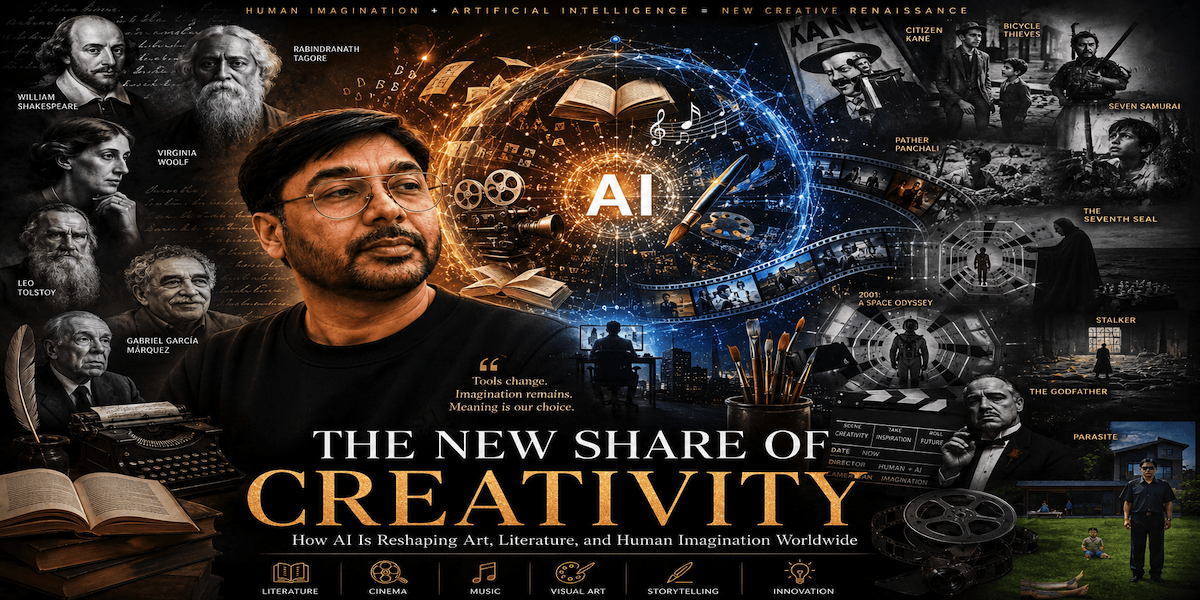
Literature’s enduring reference points. When critics argue that AI-generated prose lacks something, they are almost always comparing it, consciously or not, to a lineage running through Shakespeare’s density of wordplay and psychological interiority, Tolstoy’s and Dostoevsky’s ability to hold vast moral and social worlds inside single novels, Tagore’s fusion of regional lyricism with universal humanism, Woolf’s formal experiments with consciousness and time, Borges’s labyrinthine games with authorship and infinity, and García Márquez’s magical realism rooted in specific, lived Latin American history. What unites this list isn’t style but stakes: each writer’s work is inseparable from a particular consciousness grappling with a particular historical and emotional reality — precisely the ingredient generative models can imitate stylistically but cannot originate experientially.
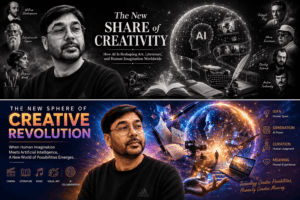
ai images of Cinema and literature
Cinema’s landmark grammar. The same logic holds for film. Citizen Kane didn’t just tell a story, it invented new grammar for how a story could be told through depth of field and structure. Seven Samurai and Rashomon built entire schools of thought around perspective, ensemble staging, and contested truth. Bicycle Thieves and Pather Panchaliproved that poverty and daily survival, observed with patience and specificity, could carry the emotional weight of any epic. The Seventh Seal staged existential doubt as literal chess with death. 2001: A Space Odyssey used pure image and sound, almost no dialogue, to stage the entire arc of human evolution and its uncertain machine successor. Stalkerturned a slow, grueling journey into a metaphysical meditation on desire and belief. The Godfather fused operatic family tragedy with the mechanics of American power. Parasite used precise class architecture – literal vertical space — to indict inequality with surgical clarity. Each of these films is a singular formal answer to a singular historical moment, made by a director metabolizing a specific culture’s anxieties into image.
Why the comparison matters for the AI debate. This canon is not invoked to dismiss AI-assisted creativity, but to locate exactly where the redistribution discussed earlier in this piece is and isn’t happening. A generative model can plausibly continue a Tolstoyan sentence or render a Kubrickian composition once prompted toward it, because style is learnable from data. What none of these works were made from, however, is data – they were made from Kurosawa’s direct experience of postwar Japan, De Sica’s and Ray’s direct encounters with poverty, Bong Joon-ho’s specific reading of Korean class structure, Márquez’s family history compressed into Macondo. That specific gravitational pull of lived history into form is the part of creativity that remains resistant to redistribution, however sophisticated the generative tool becomes — and it’s why this canon keeps resurfacing, unprompted, whenever the question “but is it really creative?” gets asked of a machine.
Conclusion: Creativity as a Negotiated Territory, Not a Fixed Property
The most honest way to describe the current moment isn’t “AI versus human creativity” but a live renegotiation of where creative agency sits along the pipeline from idea to finished work. Machines have taken over a real and growing share of generation. Humans retain – for now, and likely for a long time – the scarcer capacities of intention, judgment, cultural context, and the willingness to mean something by what they make. Whether that division holds, shifts further, or collapses entirely is not a question any single institution, artist, or model can answer alone; it will be settled the way every previous technological disruption to art was settled – slowly, unevenly, and through the accumulated choices of the people who keep making things anyway.
Sources: wikipedia and various sources available…esp Artificial intelligent. This piece is a sensitive and evolving subject; developments in AI-generated creative work, institutional responses, and public debate are moving quickly, and readers are encouraged to follow ongoing reporting for the latest developments. mail @vineet.tv@gmail.com