

Reason Against Revelation: Rationalist Rebellions Across Religions and Civilizations
Abstract
Every major civilization that has produced a dominant religious system has also produced, from within its own intellectual soil, a rationalist counter-tradition that questioned it. This article traces that pattern across three theatres — Greek and European philosophy (Plato, Nietzsche, Camus), classical India (Charvaka and Samkhya), and the Islamic world across Asia – and argues that religion’s capacity to shape a genuinely progressive life depends less on the presence or absence of dogma than on whether a tradition tolerates internal rational critique. Where such critique is absorbed, religion reforms; where it is suppressed, religion calcifies into fundamentalism.
1. Introduction: The Perennial Quarrel
Reason and revelation have never sat comfortably together. Plato distrusted the poets and priests of Athens for peddling myth as knowledge; Nietzsche accused Christianity of inverting natural values into a “slave morality”; Camus refused both religious consolation and nihilistic despair, choosing instead a clear-eyed revolt against the absurd. India, independently, produced Charvaka materialists who dismissed the Vedas as a priestly con job, and Samkhya philosophers who built a complete cosmology without needing a creator god at all. Islam, spreading from Arabia across Persia, Central Asia, South Asia, and the Malay archipelago, generated both a rationalist theology (the Mu’tazila) and a mystical humanism (Sufism), alongside the literalist currents more familiar to outside observers today.
The example running through every one of these cases is the same: a tradition’s health is measured by what it does with its internal dissenters.
2. Plato: Reason as the Ladder Out of Myth
Plato is often misread as a religious thinker because he speaks of the soul and the eternal. In fact, his target was the same as Nietzsche’s and Camus’s after him: the unexamined authority of inherited belief. The Allegory of the Cave is the clearest example — prisoners mistake shadows for reality because no one has taught them to question what they’re shown. Plato’s rationalism didn’t abolish the sacred; it relocated it, from priestly ritual to the geometry of the Forms. This is the first draft of the “religion vs. reason” argument in the Western canon: not atheism, but the demand that belief justify itself through argument rather than inheritance.
3. Nietzsche: The Death of God as Diagnosis, Not Celebration
Nietzsche’s proclamation in The Gay Science that “God is dead” is routinely quoted and rarely read in context. It was not a triumphant atheist slogan; it was a warning. Nietzsche’s example of the madman running through the marketplace shouting the news, only to be laughed at, illustrates his real point: European civilization had already hollowed out its religious foundations through science and skepticism, but hadn’t yet reckoned with the vacuum this would leave in morality and meaning. His critique of Christianity in On the Genealogy of Morals — that it converted the powerlessness of the weak into a virtue called “humility” – is a rationalist argument about the psychological function of doctrine, not merely its truth-value. This is an important distinction for India’s own Charvaka tradition, discussed below, which made a nearly identical move two thousand years earlier.
4. Camus: Revolt Without Transcendence
Camus takes the argument one step further than Nietzsche. In The Myth of Sisyphus, he refuses both religious answers (there is a God who gives life meaning) and nihilistic ones (since there is no God, nothing matters). His example of Sisyphus endlessly rolling the boulder becomes a model for living: meaning is not discovered, it is created through the act of persistent, lucid struggle. In The Rebel, Camus extends this into a political philosophy – revolt against injustice does not need religious sanction, only human solidarity. This is Camus’s answer to the question this article is ultimately asking: religion is not required to produce a progressive ethic, but a purely rationalist ethic requires its own discipline to avoid collapsing into nihilism.

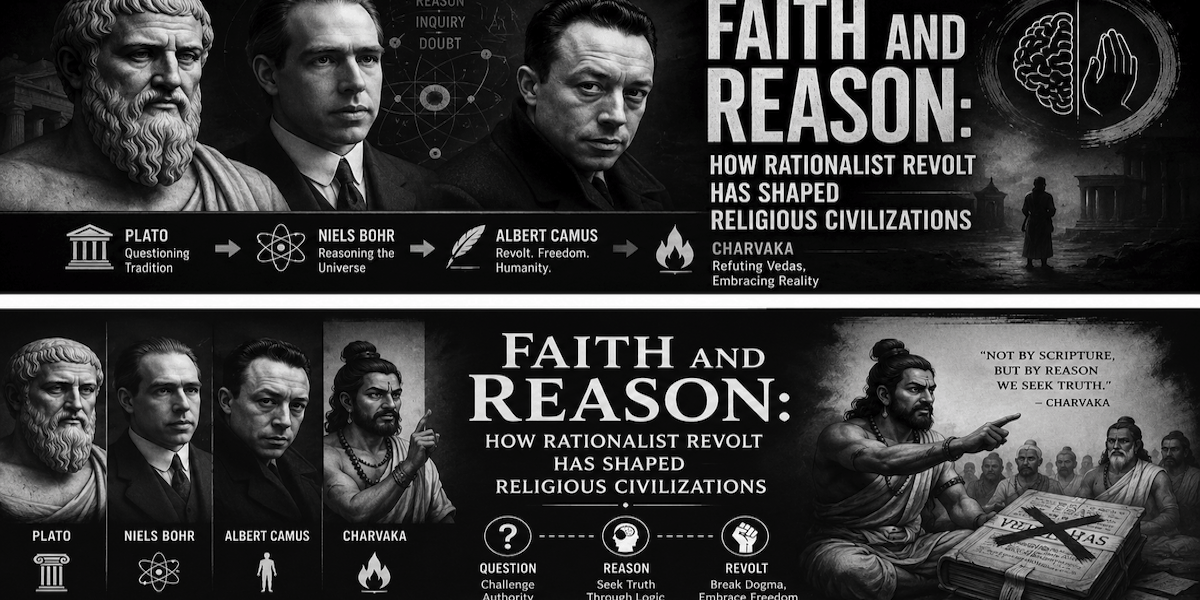
AI Image: The Great Rational Thinkers
5. India’s Own Rationalist Insurgency
5.1 Charvaka (Lokayata): The Materialist Heresy
Long before Enlightenment Europe, India had already produced a fully-formed materialist rejection of religious authority. Charvaka – known through fragments and hostile citations in rival texts, since almost none of its own literature survived priestly suppression – held that only direct sense perception counts as valid knowledge (pratyaksha), that the Vedas were composed by self-interested Brahmins, and that concepts like karma and rebirth were tools of social control rather than metaphysical facts. Its famous maxim – often paraphrased as “as long as you live, live happily; there is no escape from death” — is the Indian analogue of Nietzsche’s genealogical suspicion: religious doctrine survives not because it’s true, but because it benefits someone.
5.2 Samkhya: Rationalism from Within Orthodoxy
Samkhya is the more interesting case, because it wasn’t a heresy — it’s one of the six orthodox darshanas of Hindu philosophy, yet it is functionally atheistic. Samkhya explains the entire universe through the interaction of two principles, consciousness (purusha) and matter (prakriti), with no creator god required to set the process in motion. This is the clearest example in Indian thought of what this article calls “absorbed rationalism”: a fully naturalistic cosmology that operated inside the religious mainstream rather than against it, later supplying the philosophical scaffolding for Yoga and parts of Buddhist thought. Where Charvaka was expelled to the margins, Samkhya shows what happens when a tradition can metabolize its own skeptics instead.
6. Islam Across Asia: A Corrective on the “Fundamentalist” Premise
It is a common but inaccurate simplification that Islam across Asia has “always” been fundamentalist. The historical record shows something closer to the Indian pattern above: a rationalist current, a mystical current, and a literalist current, all competing for influence at different times and places.
The Mu’tazila (8th–10th century Baghdad) were a rationalist theological school who argued the Quran should be interpreted through reason (aql) and held that ethical values are knowable independently of scripture – a position strikingly close to Plato’s rationalism. For a period they were the dominant intellectual force in the Abbasid caliphate.
Sufism, spreading through Persia, Central Asia, and the Indian subcontinent, produced a devotional, often syncretic Islam – Rumi’s poetry and the Chishti order in India (whose shrines are still visited by Hindus and Muslims alike) are examples of religion shaping a genuinely pluralistic social life rather than a rigid one.
Reformist modernism in South Asia – Sir Syed Ahmed Khan’s Aligarh movement in the 19th century, and Muhammad Iqbal’s The Reconstruction of Religious Thought in Islam in the 20th – explicitly tried to re-inject rational, scientific inquiry into Muslim education and theology, much as Charvaka and Samkhya had tried in Hindu India centuries earlier.
Literalist and revivalist currents – Deobandi and later Salafi-influenced movements – did grow in influence from the 18th century onward, often in reaction to colonialism, and it is these movements that dominate contemporary media coverage. But treating them as the whole of “Asian Islam” erases the Mu’tazila, the Sufis, and the modernists in the same way that reducing Hinduism to its most orthodox priestly class would erase Charvaka and Samkhya.
The honest comparative point is this: every major religious tradition examined here has hosted the same three-way contest – rationalist reform, mystical/devotional reinterpretation, and literalist retrenchment. Which one wins in a given century says more about politics, colonialism, and social crisis than about anything intrinsic to the religion itself.
7. How Religion Shapes a Progressive Life: Synthesis
The examples above converge on a working thesis: religion shapes progressive life not by being replaced with rationalism, but by being forced into conversation with it.
Gandhi used explicitly religious idiom (satyagraha, ahimsa) to build a mass anti-colonial movement – an example of scripture repurposed for a modern political end rather than discarded.
B.R. Ambedkar, by contrast, concluded that Hinduism’s caste hierarchy could not be reformed from within and converted to Buddhism in 1956 – an example of exit rather than reform, echoing Charvaka’s older rejection of Brahmanical authority.
Liberation theology in 20th-century Latin America shows Christianity performing the same maneuver as Iqbal’s Islamic modernism: reinterpreting scripture (in this case, in favor of the poor) to answer a contemporary political crisis rather than retreating into pure literalism.
India’s own constitutional secularism is itself a product of this argument – a state that neither adopted Charvaka-style atheism nor a single state religion, but instead built a framework (Article 25–28) that lets rationalist critique and religious practice coexist under law.
8. Conclusion
Nietzsche, Plato, and Camus in the West; Charvaka and Samkhya in India; the Mu’tazila, the Sufis, and the modernists across Islamic Asia – none of these are isolated curiosities. They are the same structural argument recurring in every civilization that has ever organized itself around a sacred text: reason will eventually ask the tradition to justify itself, and the tradition’s future depends on whether it can answer without simply silencing the question. Progressive life, in every example cited here, has come not from the total defeat of religion by reason, or of reason by religion, but from traditions – Samkhya inside Hinduism, the Mu’tazila and Sufis inside Islam, liberation theology inside Christianity – that found a way to hold both at once.
References (short form)
Plato, The Republic; Nietzsche, The Gay Science & On the Genealogy of Morals; Camus, The Myth of Sisyphus & The Rebel; Bhattacharya, Studies on the Carvaka/Lokayata; Chattopadhyaya, Lokayata; Larson, Classical Samkhya; Radhakrishnan, Indian Philosophy; Hourani, Islamic Rationalism; Martin, Woodward & Atmaja, Defenders of Reason in Islam; Iqbal, The Reconstruction of Religious Thought in Islam; Troll, Sayyid Ahmad Khan; Schimmel, Mystical Dimensions of Islam; Gandhi, An Autobiography; Ambedkar, The Buddha and His Dhamma & Annihilation of Caste; Gutiérrez, A Theology of Liberation; Austin, The Indian Constitution. Wikipedia, various religious texts, sarvdarshan sangrah etc.
