
The 2026 Iran War: India’s Energy, Diaspora, and Diplomatic Reckoning
Energy Security, Diaspora Risk, the Islamic World’s Response, and the Limits of Multi-Alignment
1. Background
On 28 February 2026, the United States and Israel launched coordinated strikes on Iran that killed Supreme Leader Ali Khamenei and several senior commanders, opening what is now widely termed the 2026 Iran War – and, in South Asian media, the “Third Gulf War” or “Ramadan War.” What began as an air campaign against Iran’s nuclear and missile infrastructure widened within days into a multi-front conflict: Iranian missile and drone strikes on Israel, the Gulf states, and US bases; the closure of the Strait of Hormuz; Hezbollah’s entry from Lebanon; and skirmishes involving Saudi Arabia, the UAE, and Kuwait. A ceasefire process has moved in fits and starts since April – a two-week pause, an Islamabad-mediated round of talks that collapsed, a naval blockade, a June memorandum of understanding signed at Versailles – punctuated by fresh rounds of strikes, the most recent as of this writing on 8 July, when the US hit more than eighty targets after attacks on tankers in the Strait.
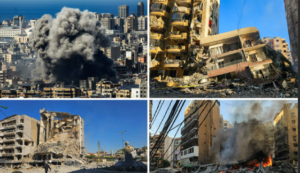
Photo: US Iran War and the devastations(file)
For India, this is not a distant war. It is a war unfolding in the maritime and labour corridor that supplies roughly half its crude oil, nearly all its LPG, a sixth of its foreign remittances, and hosts the largest single concentration of Indian citizens abroad. This article examines the war’s structural impact on India, the domestic political and religious fault lines it has exposed, how the Islamic world – including Indian Muslim opinion – has responded, and what a realistic Indian policy response looks like.
2. Why This War Cuts Differently for India
India’s 20-year “multi-alignment” strategy rested on one assumption: Iran, Israel, and the Gulf Arab states would never be at war simultaneously.
That assumption has failed:
- Chabahar port sits inside a country under active bombardment.
- A $10B defense relationship puts India adjacent to Israel, a belligerent.
- 9 million Indian workers and the Aramco refining partnership sit inside Gulf states themselves trading strikes with Iran.
- Result: India’s three West Asian pillars are no longer just in tension – they are shooting at each other.
3. The Economic and Energy Shock
| Impact area | What happened |
|---|---|
| Crude prices | Mid-$60s → $110–120/barrel at peak. Each $1 rise ≈ ₹10,700 crore added to India’s annual import bill; total crude/petroleum bill pushed toward $200B. |
| LPG & fertiliser | Refill delays >1 week in some cities; Essential Commodities Act invoked; tiered gas allocation prioritising fertiliser and household LPG. >60% of DAP fertiliser imports delayed ahead of Kharif sowing. |
| Trade & manufacturing | Crude imports fell >33%; exports contracted 7% YoY at the worst point. Petrochemical, textile, packaging sectors hit by feedstock shortages; Gulf-bound electronics rerouted at higher cost. |
| Diversification | Larger purchases from Russia, Venezuela, Canada, Brazil, Guyana; new LNG/LPG deals with US, Australia, Canada. US granted temporary sanctions waivers on Russian crude – even as broader tariff pressure on India over those same purchases continued. |
| Public signal |
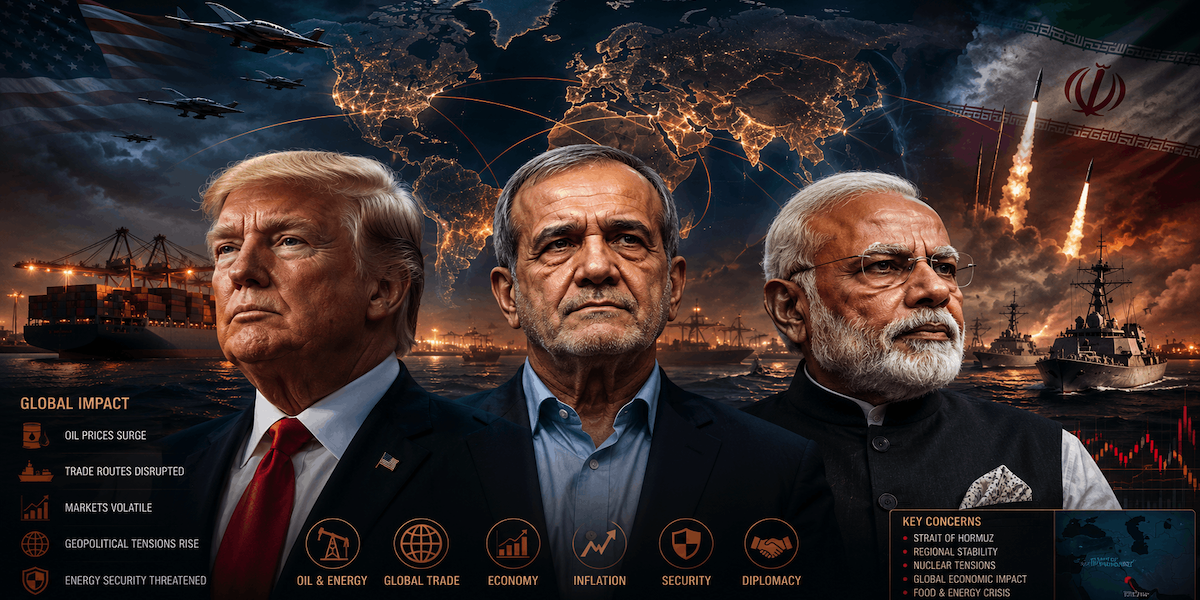
 AI Generated Symbolic Image PM Modi personally urged citizens to cut fuel use, defer foreign travel, and pause gold purchases – a marker of how seriously forex reserves and the current account are being watched.
|
Core lesson: The structural lesson many Indian energy analysts have drawn is that decades of “just-in-time” energy sourcing optimised for the cheapest, fastest route left India with almost no strategic buffer – a vulnerability now being addressed, belatedly, through supply diversification and (still incomplete) discussion of strategic LPG reserves
4. Nine Million Lives: Diaspora and Remittances
- 9.1 million Indians live/work in the GCC states — the largest single expatriate community of any country, sending home an estimated $35–50B/year in remittances (critical to household economies in Kerala, UP, Bihar).
- 1990 Kuwait evacuation: ~200,000 people. Today’s exposed population is ~45x larger, and unfolds in real time via smartphone video rather than diplomatic cable.
- Former diplomats are candid: no country, India included, can evacuate 9–10 million people in an actual war scenario.
- Actual policy: stay put, rely on Gulf host-government protection, trust accumulated goodwill. MEA has run a 24-hour control room and consular helplines and facilitated stranded-traveler returns via commercial/non-scheduled flights — but has not attempted mass evacuation, betting the Gulf states won’t become full battlegrounds.
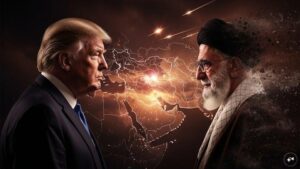
AI Generated Image of US Iran Conflict Photo: US President Trump and Iranian Leader Late khamenei
5. The Domestic Political Fault Line
Three genuinely contested positions, presented without adjudicating between them:
- Government position: calibrated, non-committal messaging; calls for de-escalation without blaming either side. Rationale — India has real interests on all sides (Gulf/Iran energy, Israeli defense tech, US relationship), so silence is discipline, not indecision.
- Opposition critique: Congress and others call this neutrality an abdication – noting Iran’s 1994 diplomatic support for India at the UN Human Rights Commission (blocking an OIC Kashmir resolution), and Modi’s pre-war Knesset address as, in critics’ view, tacit alignment. This is contested political terrain, not settled fact.
- Communal/religious dimension: Khamenei’s killing triggered protests in Hyderabad and J&K, with some religious leaders framing the strikes as an attack on the broader Muslim ummah. This reflects genuine Shia community sentiment – not a uniform “Muslim” or “Islamic” opinion, and treating it as such would flatten a diverse population.
6. “The Islamic World’s Opinion” – More Fragmented Than It Looks
There is no single Islamic-world position. Five distinct threads:
- Iran’s framing: explicitly pan-Islamic. Officials like Ali Larijani rebuked Gulf states (UAE especially) for not backing Iran, invoking religious duty and calling for a unified Islamic coalition; some clerics issued fatwas framing resistance as religious duty.
- Gulf Arab/Sunni governments: largely avoided aligning with Iran; some fought back militarily after being struck; emergency Riyadh/Doha meetings produced statements, not collective action — consistent with longstanding Sunni-Shia and geopolitical rivalry.
- The OIC: criticised — including by Iranian officials — for a limited, rhetorical response, in line with its historical pattern.
- India and the OIC: never admitted, membership blocked by Pakistan over Kashmir since the OIC’s founding. India engages Muslim-majority states bilaterally instead.
- Iranian public sentiment: hard to verify under information controls, but reporting suggests broad rejection of civilian-infrastructure strikes regardless of one’s view of the regime.
Bottom line: an Iranian state narrative of pan-Islamic solidarity, Sunni governments balancing self-interest against sympathy, a cautious OIC, and grassroots religious sentiment (including in India) that tracks no government’s line — these are four separate things, not one “Islamic opinion.”

Ai Generated image of Hormuz Strait
7. What Are the Realistic Solutions?
Any credible recommendation set separates what India can control from what it cannot.
Energy & economic security
| Action | Realism | |
|---|---|---|
| 1 | Build actual LPG/diesel strategic reserves, not just crude | High – budget/infrastructure problem, not diplomacy. Closes a real gap the crisis exposed. |
| 2 | Institutionalise diversification (Russia/Americas/Australia/Africa) as permanent policy | Medium – already happening, but bounded by US tariff pressure India doesn’t control. |
| 3 | Accelerate renewables/domestic gas to cut Hormuz dependency | Long-term only – a decade-scale transition, not a fix for this war. |
Diaspora protection
| Action | Realism | |
|---|---|---|
| 4 | Pre-position naval/civil-aviation evacuation capacity (Op Sankalp model) | Partial – incremental extension of existing posture; no sealift solves a 9M-person evacuation. |
| 5 | Formalise a real-time diaspora welfare/information channel | High — extends the existing MEA control-room model; bureaucratic lift, not geopolitical. |
Regional diplomacy
| Action | Realism | |
|---|---|---|
| 6 | More visible (still low-risk) public advocacy for de-escalation at the UN | High to do, low ceiling — costs India nothing, but won’t move Washington/Tel Aviv/Tehran. |
| 7 | Protect Chabahar’s civilian/commercial character via continued Tehran engagement | Low – largely hostage to US sanctions posture and Iran’s post-Khamenei leadership, not Indian diplomacy. |
| 8 | Use India’s dual-facing position (Muslim population, Gulf ties, Israel defense relationship, Iran history) as diplomatic leverage | High – few states can credibly talk to all three sides; this is a genuine asset. |
Islamic-world dimension
| Action | Realism | |
|---|---|---|
| 9 | Keep domestic Shia-community sentiment a social-cohesion issue, not a foreign-policy input | High – a framing discipline, not a resource question. |
| 10 | Don’t expect OIC engagement to change | Certain – structural, Pakistan-driven exclusion; unaffected by this war’s outcome. |
Honest summary: Items 1, 5, 8, and 9 are real, executable wins regardless of how the war ends. Items 2, 4, and 6 are directionally right but bounded by actors India doesn’t control. Items 3 and 7 are aspirational or hostage to others’ decisions. Item 10 isn’t a policy problem to solve — it’s a ceiling to accept.
8. Conclusion
The 2026 Iran war is the first real stress test of India’s multi-alignment strategy in West Asia. It has exposed genuine structural gaps — in energy buffers, evacuation capacity, and the core assumption that India’s regional partners would never turn on each other.
The domestic debate over neutrality, and the fragmented question of “Islamic opinion,” are both live and contested — this piece has tried to present the range of views rather than settle them.
What’s less contestable is the direction of travel: deeper strategic reserves, more credible evacuation planning, diversification sustained by design rather than crisis, and a diplomatic posture that uses India’s unusual position — trusted, imperfectly, by Tehran, Tel Aviv, and the Gulf capitals alike — rather than retreating into pure silence.
Courtsy:Wikipedia (2026 Iran war; Reactions to the 2026 Iran war; Organisation of Islamic Cooperation); Britannica; Al Jazeera; CSIS; Congressional Research Service; House of Commons Library; Forbes; CNBC; New Lines Institute; EPIC-India; VisionIAS; The Federal; Iran International — accessed July 2026.