

The Architecture of Emotion: How Cinema’s Greatest Composers Shaped the Sound of Feeling – and What AI Music Can Never Replace
A Research Article
Introduction:
There is a reason you weep at a film you have seen before, even when you know exactly what will happen. The reason, more often than not, is the music. A film score is not decoration – it is a parallel narrative running beneath the dialogue and image, speaking directly to the limbic system, bypassing conscious thought entirely. It tells you when to be afraid before the monster appears, when to grieve before the character speaks, when the love is doomed before the lovers touch.
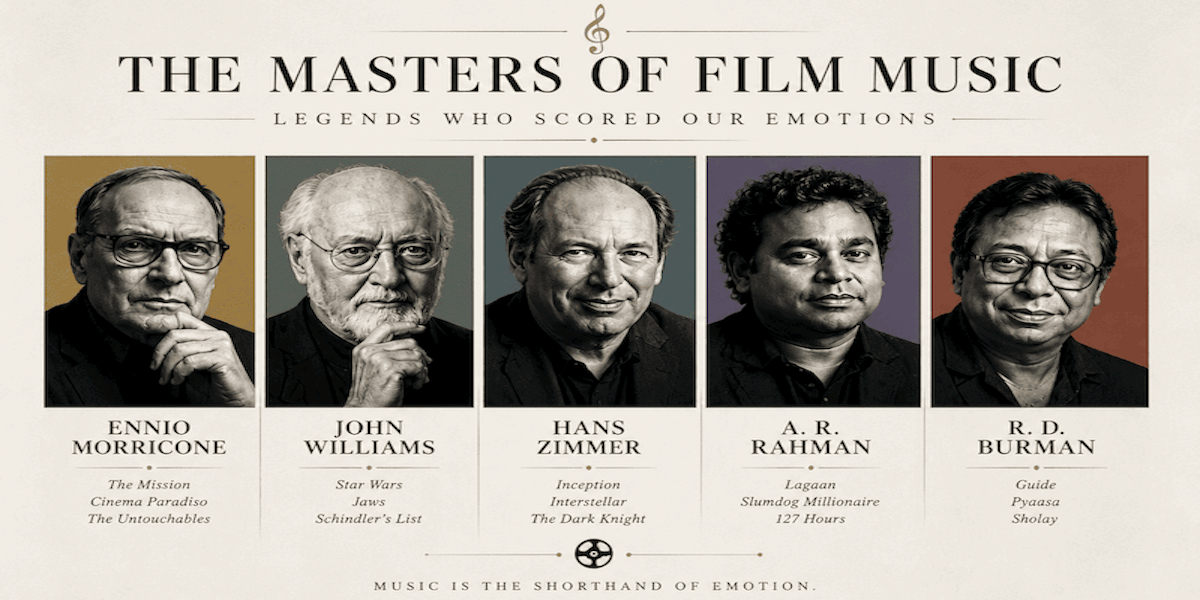
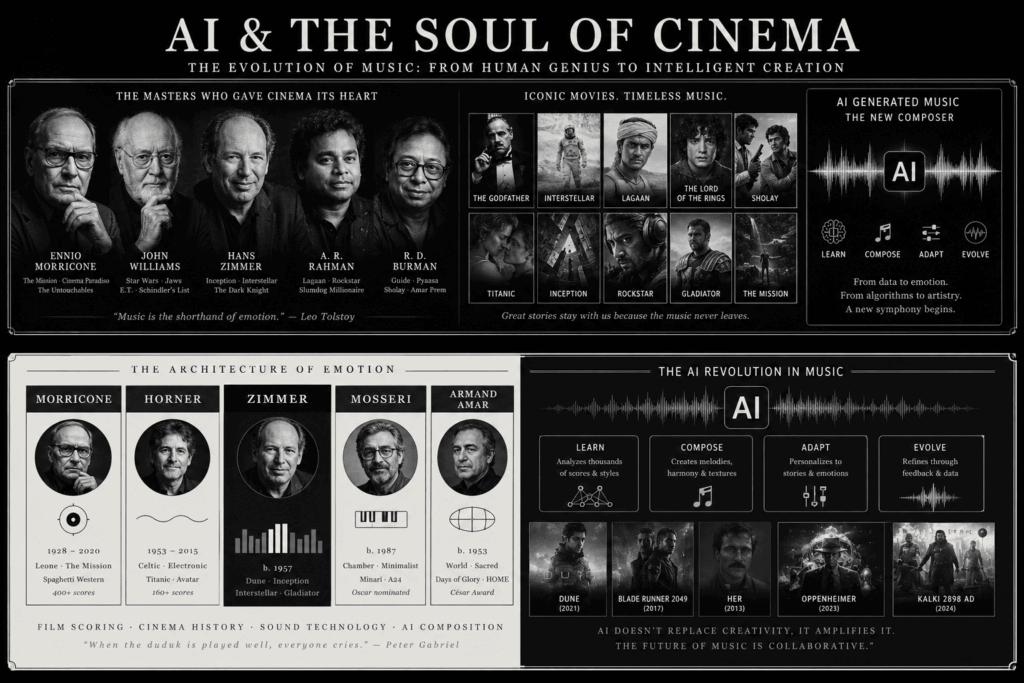
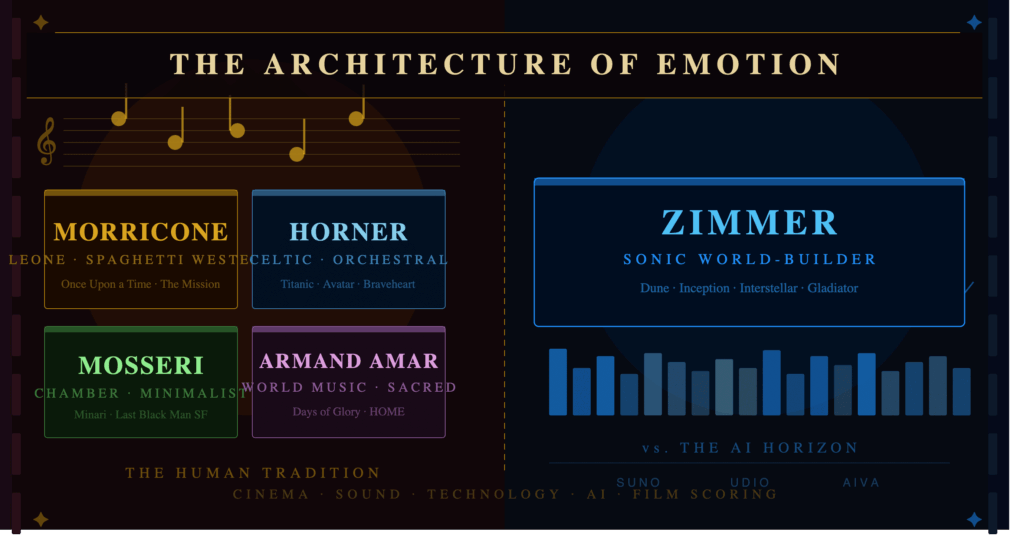
This article traces the arc of cinematic soundtrack technology and compositional philosophy across six decades — from Ennio Morricone’s revolutionary experimentalism of the 1960s, through James Horner’s emotional architectures of the 1990s and Hans Zimmer’s sonic world-building of the 2000s–2020s, to Emile Mosseri’s intimate chamber minimalism of the present – and then asks the central question of our moment: what happens when artificial intelligence enters this equation?
Part I: The 1960s–1980s – Breaking the Orchestra
Ennio Morricone and the Grammar of Sound
Any serious examination of film scoring must begin in Rome, 1964, when Ennio Morricone and director Sergio Leone created a score that did not merely accompany a film – it redefined what a score could be.
Morricone was, by his own admission, working under budget constraints on A Fistful of Dollars. The scarcity became the source. With limited access to a full orchestra, he turned to gunshots, cracking whips, whistles, voices, a Jew’s harp, mariachi trumpets, and the newly available Fender electric guitar. The result was not a compromise – it was a revolution. What Morricone called “contamination” – the mixing of archaic modal melodic lines reminiscent of medieval music with contemporary pop textures – produced something that had never existed before.
The philosophical principle behind this is significant. In an era when Hollywood maintained the late-Romantic full-symphonic sound (Aaron Copland’s Americana, Dimitri Tiomkin’s country ballads), Morricone rejected convention entirely. His approach to the leitmotif was different from the Wagnerian-Hollywood tradition. Where Star Wars would give each character their own identifiable theme, Morricone wrote the same theme for all three characters in The Good, the Bad and the Ugly – the music reflected not the individuals but their shared moral atmosphere, their shared world.
The craft was total. Unlike virtually every major Hollywood composer of his era and since, Morricone orchestrated every note himself — he wrote not just the melody and chord progressions but every single instrument part. He refused to delegate orchestration, because he understood that orchestration is the composition. The choice of which instrument carries a line, at what register, against what harmonic backdrop – these are not aesthetic details but emotional decisions.
His score for The Mission (1986), which he considered his personal masterpiece, demonstrates this principle at its highest level. The film’s three narrative forces – the oppressive Church, the indigenous Guaraní culture, and Jesuit idealism – each receive distinct musical characters. The result is a score that is simultaneously Renaissance polyphony, indigenous instrumentation, and European orchestral writing, held together by the internal logic of Morricone’s singular voice. Over a career spanning more than 400 films and 100 concert works, he sold over 70 million records — numbers that suggest something beyond commercial success: a composer who reached the universal through the specific.
The Technology of the Era
Morricone’s greatness was, crucially, not despite the technology of his time but shaped by it. In the 1960s and early 1970s, film scoring happened entirely in the analog domain: magnetic tape, live recording sessions, physical splicing. The composer worked with real musicians in real rooms. There was no digital editing, no sampling, no click tracks easily synchronized to picture. Music had to be written with a deep understanding of time, pacing, and the psychology of listening, because mistakes were expensive and revision was slow.
This constraint produced extraordinary discipline. When Morricone wrote a cue for Once Upon a Time in America (1984), Leone had the music performed live on the sound stage as the camera rolled – the image was built around the score, not the other way around. This inversion of the standard workflow (where music is added last) reflects a philosophy: the music is not illustration; it is co-author.
Part II – The Euro-Asian Magic of Duduk
The Underground Liturgists: Popol Vuh, Armand Amar, Peer Raben, and the Magic of the Duduk
Among the most singular and philosophically serious figures in cinematic music history are those who worked outside the Hollywood mainstream, bringing spiritual, political, and cross-civilizational depth to the soundtrack — composers for whom the choice of instrument was itself an ethical act.
Popol Vuh, the German musical collective founded by keyboardist Florian Fricke in 1969, began as an electronic music project before abandoning synthesizers entirely for organic instrumentation and world music influences, developing a defining partnership with director Werner Herzog across films including Aguirre, the Wrath of God (1972), Nosferatu the Vampyre (1979), and Fitzcarraldo (1982). What made this collaboration so philosophically extraordinary was the direction of its moral gaze: Popol Vuh’s music did not celebrate the protagonists – the conquistadors and imperialists at the center of Herzog’s films — but rather the cultures those figures were trying to subjugate and control, creating a profound counterpoint that ran beneath the image like a subterranean conscience. Between the captivating choral work for Nosferatu, the operatic classicism of Fitzcarraldo, and the breathtaking lushness of Cobra Verde, Fricke’s compositions inspired a generation and redefined the art of the soundtrack. Fricke’s musical trademark – peaceful, acoustic and electric dreamscapes with many native and ethnic elements – gave Herzog’s films their peculiarly somnambulistic, almost trance-like intensity, the independent nature of his music proving a conceptual asset to films that often had a dreamlike character.
A figure of comparable moral seriousness but entirely different geography is Armand Amar, born in Jerusalem and raised in Morocco, imbued from childhood with the sounds of instruments considered exotic at the time – a composer who taught himself tabla, zarb, and congas, studying under various masters of traditional and classical music before ever writing for the screen. This autodidactic, cross-civilizational formation is audible in everything he has scored. His music does not borrow world traditions as texture or atmosphere; it speaks in them, treating Persian strings, African percussion, and Sufi vocal traditions as primary languages rather than coloristic additions. His film scores include Days of Glory (2006), Live and Become (2006), The Concert (2009 — for which he won the César Award for Best Original Music), HOME (2009), and long-running collaborations with both Costa-Gavras and Radu Mihaileanu. For Days of Glory, about North African soldiers fighting and dying for a France that refused to recognize them after the war, Amar instinctively understood that a European orchestral score would constitute a second act of erasure. His answer was to find music that these soldiers might have carried in their bodies – to let their culture speak for itself on the soundtrack of a film about their invisibility. In 1994, alongside his friend Alain Weber and Peter Gabriel, he co-founded the record label Long Distance, dedicated to traditional, world, and classical music from across the globe — an institutional commitment to the idea that the musical knowledge of non-Western traditions deserves preservation, not merely occasional sampling.
In Germany, a parallel seriousness operated under entirely different aesthetic conditions. Peer Raben was the composer inseparable from Rainer Werner Fassbinder, collaborating with the filmmaker on over 30 films, with scores that became synonymous with some of the best of New German Cinema. Raben’s music for Fassbinder is structured around repeated melodic fragments derived from music-hall and cabaret numbers, military marches, German pop songs, and traditional liturgical music — a distinctly urban sound, evocative of wind-up street-corner barrel organs and smoke-filled piano bars, filled with diverse elements contrasting and colliding like sounds heard from a city block. This was not incidental — it was Brechtian by design. Fassbinder’s cinema was built on the alienation effect, the deliberate interruption of emotional immersion to force political thought, and Raben’s music served this aim precisely: familiar enough to trigger emotional memory, strange enough in its juxtapositions to make that emotion visible as a social construction. His twinkling glockenspiels and childlike repetitions underneath scenes of crushing social oppression created exactly the ironic distance Fassbinder needed — the gap between what the music suggested and what the image showed was where the politics lived. Turner Classic MoviesFilm Comment
But perhaps no single instrument tells the story of cinematic emotion more nakedly than the duduk — the Armenian double-reed wind instrument made from apricot wood, whose sound has been described, simply and accurately, as the closest thing to the human voice that any instrument achieves. The duduk is a humble folk oboe, carved out of apricot wood, but its great master Djivan Gasparyan made its melancholy sound a resonant symbol of the suffering of his nation. Gasparyan’s relationship to cinema was almost mythic in its origins: the masterless eight-year-old boy who had his first encounter with his instrument at the old movie theater in the village of Solak, watching a silent film accompanied by a duduk player – for him, it was the instrument that starred, not the film. Decades later, Peter Gabriel fell in love with the duduk during research for the film score of Scorsese’s The Last Temptation of Christ, noting that in Armenia they say: “when the duduk is played well, everyone cries.” Gasparyan collaborated with Hans Zimmer in making the soundtrack for Ridley Scott’s Oscar-winning Gladiator, with Zimmer stating that Djivan was the only musician he truly wanted to play the Armenian instrument for the score. The duduk’s archaic and mournful sound has since been employed across a range of films to depict otherworldliness, loneliness, mourning, and a Central Asian or Middle Eastern atmosphere — appearing in Syriana, Blood Diamond, The Passion of the Christ, and beyond. What the duduk brings to cinema is something no synthesizer can replicate: the sound of a specific people’s grief, distilled over millennia into a tube of apricot wood with a range of just one octave. The great American-Armenian writer William Saroyan heard Gasparyan play and told him plainly: “This is not music; this is a prayer.” In cinema, the greatest scores have always been prayers in disguise — and the composers in this tradition knew it.
Part III: The 1990s – Emotion at Scale
James Horner and the Architecture of Feeling
If Morricone was the revolutionary, James Horner was the master craftsman of mass emotional experience. Working in the Hollywood blockbuster tradition, Horner developed a compositional voice that could move millions of people simultaneously — and his instrument for this was not experimentation but precision.
Horner’s defining technical signature was the integration of choral and electronic elements alongside traditional orchestrations, combined with a deep affinity for Celtic musical idioms. For Titanic (1997), he deployed this vocabulary with particular sophistication. Rather than following the standard Hollywood leitmotif system (a theme per character), Horner built the score around emotional states — the romantic, the tragic, the epic — each mapped onto specific instrumental colors.
The choice of uilleann pipes and vocalist Sissel Kyrkjebø for the wordless vocal lines was not arbitrary. Director James Cameron had originally intended Enya to compose the music, and Horner built his score with that atmospheric, timeless quality in mind — though he ultimately refused a digital choir in favor of a synthesized version performed by hand, because he wanted to avoid a “church-like sound.” The distinction mattered: one emotional register rather than another, chosen with complete intentionality.
Horner also operated by a principle he articulated explicitly: he was “attached to emotions and attitudes,” not to the mathematical deployment of themes. He criticized the Star Wars leitmotif model as “a very mathematical conception” and explicitly invoked Morricone as a counter-example — the scene-focused rather than character-focused approach. The Titanic score, selling over 27 million copies and becoming the highest-selling primarily orchestral soundtrack in history, is a testament to how profoundly right this emotional philosophy was.
The score for Avatar (2009) extended these principles into a new sonic frontier. Horner worked exclusively on it for over two years, describing it as “the most difficult film I have worked on.” Here he created what critics have called an “organic” sound for the world of Pandora — a careful blending of choral Orffian chanting, percussion-driven action, and delicate melodic material that carried the emotional arc of an environmentalist narrative set in an entirely imaginary ecosystem. One critic has called it “the finest film score of the 21st century.”
The Technology Shift: Digital Arrives
The 1990s saw the introduction of Digital Audio Workstations (DAWs) — software environments where music could be recorded, edited, and mixed on a computer. This was transformative. For the first time, a composer could work with unlimited track counts, instant editing, and virtual instruments. The click track became standard practice, allowing music to be perfectly synchronized to picture at every frame.
But as another development of the era revealed, digital technology also introduced new pressures. Horner noted that modern film composing had become so compressed in timeline — “six to eight weeks” from assignment to finished score — that composers increasingly relied on orchestrators because a single person could not otherwise complete the work. Where Morricone had written every note himself across a more generous timeline, the studio system had industrialized the process.
This created a paradox that would deepen in the decade to come: the tools were becoming more powerful at exactly the same moment the conditions for their human use were becoming more constrained.
Part IV: The 2000s–2020s – Sonic World-Building
Hans Zimmer and the Architecture of Experience
Hans Zimmer is the dominant figure in contemporary film scoring not because he is the most technically traditional composer but because he is the most technically unorthodox — a composer who has consistently asked not “how do we score this scene?” but “what does this world sound like?”
Zimmer’s philosophy is most clearly articulated in his work on Dune (2021). His challenge, as he framed it, was simple and radical: “We’re supposed to be on a different planet, different culture, we’re supposed to be in the future. Why would I have a romantic Northern European orchestra?” His response was to spend a week in Utah listening to the desert, to commission entirely new instruments, and to build a score from ancient woodwinds (the Armenian duduk), 20th-century avant-garde choral techniques, and contemporary electronic synthesis. The score features PVC tubes, invented instruments, and sounds that exist nowhere else. Its lack of traditional melodic thematic content was itself a compositional choice — the sound design was the theme.
This approach traces back to Inception (2010), where Zimmer built the entire score from a single slowed-down note of Édith Piaf’s “Non, Je ne regrette rien” — a technique that mirrors the film’s own premise of manipulation and time dilation. For Interstellar (2014), he used layered ostinatos — short repeating musical phrases — over three simple chords to create a sense of cosmic inevitability and relentless forward motion. His signature technique here, as one analysis puts it, is that a piece “is not built on complex chord progressions” but on texture, layering, and timbre — the same three chords return, transformed by what surrounds them.
Zimmer also pioneered the mainstreaming of orchestral sampling in Hollywood – he and his team at AIR Studios were among the first to develop serious orchestral libraries. The Zimmer approach — combining live orchestra with electronic textures, treated instruments, and synthesized sounds — became so influential that it now defines the default sound of the Hollywood blockbuster, for better and worse.
The “Zimmer sound” has been both celebrated and critiqued for exactly this reason. His influence is so pervasive that a generation of film scores sound like variations on his vocabulary. The four-note horn blast that dominates trailers across the industry (the so-called “Inception BRAAAM”) originated in his work and became a meme precisely because it proliferated so widely as to become cliché.
Technology as Instrument
Zimmer’s relationship to technology is unlike any previous generation of film composers. He does not merely use technology as a production tool — he uses it as a compositional instrument. The Osmose (an expressive polyphonic synthesizer that allows keyboard players to add vibrato and pitch modulation) was central to the Dune score. He builds instruments from scratch. He records in surround sound as a compositional choice, not a post-production one.
This represents a fundamental shift: the line between composition and sound design, between composer and audio engineer, has dissolved. A Morricone score was conceived as notation and realized in a room with musicians. A Zimmer score is conceived as a sonic experience and may involve dozens of collaborators, custom instruments, and audio processing techniques that have no notation equivalent.
Part V: The 2020s – Intimacy and the New Minimalism
Emile Mosseri and the Score as Memory
In deliberate counterpoint to the maximalist tradition stands Emile Mosseri, whose Oscar-nominated score for Minari (2020) represents a different philosophical inheritance: chamber minimalism in service of emotional honesty.
Mosseri’s approach to Minari was unusual in process as well as sound. He composed many of the original themes with only the script — before the film was shot. He sent sketches to director Lee Isaac Chung before he was even officially hired, and editor Harry Yoon built the film’s editing around Mosseri’s demos rather than using temp tracks. The music came first. This inversion of normal workflow — closer to Leone and Morricone’s pre-composition method than to standard Hollywood practice — gave the music exceptional organic integration.
The sonic palette Mosseri built was deliberately hybrid and unstable. He used a detuned 1940s guitar — lowered as far as it could go while still holding intonation — paired with a 1980s Korg Mono/Poly synthesizer for its “theremin-like quality,” and his own voice humming throughout. These were then supported by a 40-piece string orchestra recorded in Macedonia. The goal, as Mosseri articulated it, was “to combine organic elements with synthetic ones” to create “instability” – “a warm beating heart, the glow of the human soul, but also dissonance and strain.”
Critically, the score made no attempt to sound Korean or American. Chung’s directive was explicit: no twangy guitars, no “overtly Korean” references. The music was to evoke something more fundamental — “childhood memory,” the gauzy, partial, emotionally-loaded quality of a man’s recollection of his boyhood. The music’s role was not to represent but to feel.
This is compositional philosophy at its most sophisticated: using music to define the film’s register (emotional memoir rather than documentary) rather than its content (Korean or American identity). The critic from Berklee noted that Mosseri “wrote music that didn’t directly reference the film’s visuals or dialogue but that nonetheless was able to get right to the heart of the story.” This is, at its core, the highest ambition of film scoring — to communicate what images alone cannot.
Part VI: The Rupture – AI-Generated Music Enters Cinema
What the Machines Can Do Now
The arrival of generative AI music platforms represents the most significant disruption to the film scoring industry since the introduction of the DAW. By 2026, platforms like Suno (v5.5), Udio, AIVA, and Google’s Lyria 3-based ProducerAI can produce complete songs — orchestrated, mixed, mastered — from a text prompt in under 60 seconds.
The technical capabilities are genuinely remarkable. Suno’s v5.5 model (the current flagship as of 2026) can generate tracks up to 8 minutes in length, supports over 1,200 genre tags, includes voice cloning, and has 2 million paying subscribers with $300 million in annual recurring revenue. Udio, built by former Google DeepMind engineers, offers superior instrumental audio fidelity and compositions up to 15 minutes — arguably long enough for a film’s third act. AIVA, which specializes in orchestral and cinematic scoring, offers full copyright ownership on its Pro plan — a critical distinction for sync licensing.
The legal landscape has been turbulent. In 2024, Universal Music Group, Sony Music, and Warner Music Group filed $500 million lawsuits against both Suno and Udio for alleged copyright infringement in their training data. By late 2025, Udio settled with UMG and Warner, entering licensing partnerships. Warner settled with Suno. The industry is moving, however slowly, toward a licensed AI music ecosystem.
For practical application in film, these tools have found genuine niches. AI excels at generating ambient atmospheric textures, consistent background scoring for documentary and streaming content, temp tracks for director previsualization, and thematic consistency across episodic content where musical continuity is needed across hours of material. Some working composers use tools like AIVA and Suno to generate compositional sketches and initial melodic ideas, then develop these by hand – AI as ideation accelerant rather than final output.
The Fundamental Gap
Yet when we set these capabilities beside the compositional philosophies examined above, a fundamental gap becomes visible – and it is not primarily a gap in technical quality. The gap is intentional.Consider the central compositional act of each composer we have examined:
Morricone chose a Jew’s harp not because algorithms suggested it but because irony and black humour were the emotional truth of Leone’s film, and the Jew’s harp carries a quality of sardonic commentary that no other instrument achieves in quite that way. This was a meaning decision, not a pattern decision.
Horner secretly recorded “My Heart Will Go On” without Cameron’s knowledge because he understood that Cameron’s instinct (no pop song over the credits) was emotionally wrong for the story. He was arguing with his director from a position of emotional conviction about what the film needed. AI cannot have this argument.
Zimmer spent a week in the Utah desert listening before writing a single note of Dune because he believed the music needed to carry the desert’s actual acoustic personality — its silence, its scale, its indifference. This phenomenological grounding cannot be extracted from a prompt.
Mosseri composed from the script alone, months before the film existed, because he recognized that the score’s role was to define the film’s emotional register as memory rather than as event — a philosophical interpretation of the material, not a response to it.
In each case, the compositional act begins with an act of interpretation — a reading of what the film means, not merely what it shows. AI tools, as they currently exist, analyze and reconstruct patterns from existing music. They can replicate the style of emotional scoring with increasing fluency. They cannot perform the act of original interpretation that produces a score no algorithm would have predicted.
As one film industry commentator has noted with pointed precision: “An AI might replicate the Zimmer style, but it wouldn’t have conceived the creative choice of manipulating an Édith Piaf track to mirror the film’s core theme of bending time.” The Inception score is not a style; it is a thought.
The technical synchronization challenge reinforces this. Hit points — moments where music must perfectly coincide with specific action or emotion on screen – require “a sensitivity that goes beyond algorithms.” John Williams’s chase music in Raiders of the Lost Ark matches each step of Indiana Jones’s escape from the boulder; the music follows the character’s physical rhythm while simultaneously elevating the scene’s comic-heroic register. This requires not just timing but interpretation of tone.
The Homogenization Risk
There is a structural danger in the AI music moment that extends beyond questions of quality. When any large number of films use tools trained on the same datasets, the scoring vocabulary of cinema converges. The individual voice — Morricone’s medieval-modal-pop contaminations, Horner’s Celtic-electronic hybrids, Zimmer’s synthesized deserts, Mosseri’s wobbly detuned memory-texture — disappears into a statistically averaged middle ground.
This risk is not hypothetical. Critics of the contemporary AI-adjacent scoring tradition (the Zimmer derivatives, the trailer music clichés) already note that “scores that may lack originality” emerge when composers follow established patterns rather than inventing from the specific demands of the specific film. AI amplifies this tendency exponentially — it is, by design, a pattern-completion system. Its defaults are the statistical center of all music it has learned from.
The Morricone lesson here is bracing: his greatest scores emerged precisely from his refusal to reproduce existing patterns. The electric guitar in A Fistfall of Dollars was bizarre, unexpected, aesthetically wrong by every existing standard – and it was exactly right. The wrong choice that is also the true choice is a move that requires lived experience, artistic courage, and genuine interpretation. It is not what an algorithm optimizes for.
Part VII: Synthesis – The Two Traditions and Their Future
What Will Actually Happen
The most honest forecast is not replacement but bifurcation. The film industry will likely divide into two tiers, each with a different relationship to AI music:
The industrial tier – streaming content, corporate video, documentary background scoring, episodic television with compressed budgets — will adopt AI music tools with speed. The cost differential is simply too large to ignore. Where a human composer charges thousands of dollars and weeks of time, AI delivers studio-quality output in seconds at minimal cost. For content where music is functional rather than expressive, this is a rational choice.
The artistic tier – prestige cinema, auteur films, and projects where the score is itself a creative statement — will continue to commission human composers. The reason is not sentimental but functional: the interpretive dimension of composition is not a luxury but a necessity for films that aspire to emotional depth. A Mosseri score for Minari cannot be produced by a text prompt because the score is an argument about the film’s meaning, and that argument requires a human mind capable of forming and defending a position.
The most likely near-term development is the hybrid model: composers using AI as a generative drafting tool — producing hundreds of melodic sketches in hours rather than days — and then selecting, transforming, and completing the material by hand. This compresses the ideation phase while preserving the interpretive act. The creative authority remains with the composer; AI provides expanded raw material.
The Deeper Question
Underlying all technical debates is a philosophical one: what is film music for?
If it is for filling acoustic space with appropriate emotional texture — providing sad music for sad scenes and tense music for tense ones — then AI can already do this adequately, and will soon do it excellently.
But if film music is for what Morricone, Horner, Zimmer, and Mosseri have each demonstrated it can be at its highest — a parallel intelligence that finds the emotional truth of human experience and speaks it in a language that bypasses language entirely — then no text prompt, however sophisticated, has yet generated an equivalent.
The irreducible element is not technical skill. It is the composer’s lived experience of being human, which gives them the authority to speak about what it costs to love, to lose, to remember, to grieve. When the camera holds on a character’s face in silence and the music enters, what it says in that moment is the product of every human experience the composer has ever had. That is what audiences feel, even if they cannot articulate it. It is what makes them cry at films they have seen before.
Ennio Morricone wrote his first composition at age six. He completed his four-year conservatory program in six months. He scored more than 500 films and never delegated a single note of orchestration. He died in 2020, having changed what music is allowed to be.
The question the AI moment asks is not whether machines can replicate this. They probably can approximate it more closely than we expect. The question is whether the approximation will satisfy us – or whether we will continue to demand the real thing.
Conclusion: The Enduring Claim of the Human Voice
The history of cinema music is a history of individual minds solving an impossible problem: how do you put sound to the interior of experience? How do you score a memory? How do you make an audience feel, in a darkened room, what a fictional character feels in a fictional world?
Morricone did it with a Jew’s harp and a gunshot. Horner did it with uilleann pipes and a digital synthesizer. Zimmer did it with PVC tubes and a week in a desert. Mosseri did it with a detuned guitar and his own voice humming.
In each case, the answer was particular – specific to one composer’s consciousness, one film’s emotional logic, one moment in the history of what cinema was trying to do. The particularity is not incidental. It is the source.
AI music, in 2026, can generate the architecture of emotion with remarkable facility. What it cannot generate — yet — is the emotion itself. The feeling that a score was made by someone who has known loss, who understands what it means for the world to be too large and a person too small within it, who chose this instrument and not that one because of what it says about being alive.
Until the day, if it comes, when machines know what it is to be alive, that will remain the irreducible claim of the human composer. The rest is merely very good carpentry.
Sources:
Note: Armand Amar “renetto vaccine” Rainer Werner Fassbinder’s composer Peer Raben – “renetto” sounds like Raben/Rabenbauer, “vaccine” could be a garble of his surname”magic of duduk” the duduk (Armenian oboe) and its great masters in cinema — particularly Djivan Gasparyan, whose duduk defined the sound of scores like Gladiator, The Crow, and Peter Gabriel’s soundscapes
Sources: consulted include materials from Wikipedia, The Conversation, the Science and Media Museum blog, Berklee Now, Variety, The Hollywood Reporter, Spitfire Audio Composer, Billboard, Classic FM, MusicTech, Envato Elements, San Francisco Conservatory of Music, and multiple film music analysis publications. All composer quotations drawn from primary interviews and documented sources.senses of cinema etc.
