
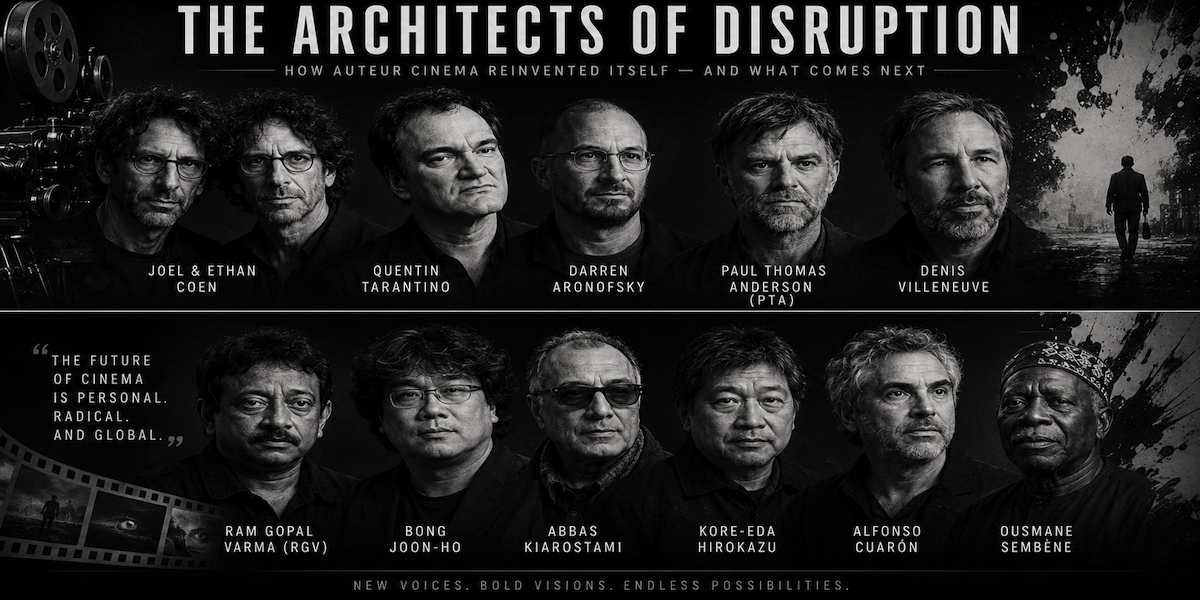
The Architects of Disruption: How Auteur Cinema Reinvented Itself — And What Comes Next
Preface: Cinema as a Language That Refuses to Stay Fixed
(Published by APFORG | Cinema & Culture Vertical)
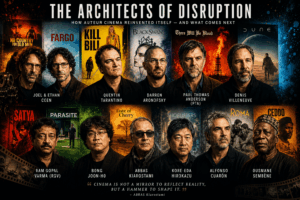
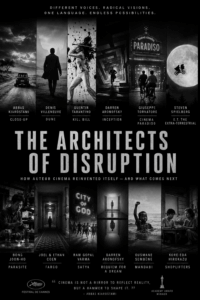
Every generation of filmmakers inherits a grammar. Some use it faithfully. A rare few tear it apart and rebuild it into something that makes predecessors look like rough drafts. This article traces three generational waves of such architects – directors who didn’t just make films, but rewrote the conditions under which films could be made and understood. From the formal deconstruction of the Coen Brothers, through the maximalist confrontation of Tarantino, into the fragmented interiority of Aronofsky and Anderson, across the global pluralism of Zhao, Lanthimos, Villeneuve, Kashyap, Varma, and Rajamouli – and then asks the question cinema has always forced us to ask: what comes next?
Part I: The Coen Brothers – Form as Irony, Genre as Archaeology
Joel and Ethan Coen arrived in 1984 with Blood Simple, a film noir that treated the genre not as a template but as a corpse worth examining. Their innovation was not technical in the conventional sense – it was philosophical. They understood that genre itself carries meaning, that the Western or the thriller or the screwball comedy is not merely a mode of delivery but a belief system. Their project was to excavate those belief systems and expose them to irony.
The Stylistic Signature
The Coens’ visual language is defined by a paradox: immaculate control deployed in the service of randomness. Their compositions are precise — wide angles that dwarf characters within landscapes, deep focus that makes environments feel conspiratorial, close-ups that arrive with an almost clinical neutrality. Yet their narratives repeatedly insist that fate is arbitrary, that violence is senseless, that the universe offers no moral accounting. This tension between formal rigidity and thematic chaos is their central aesthetic contribution.
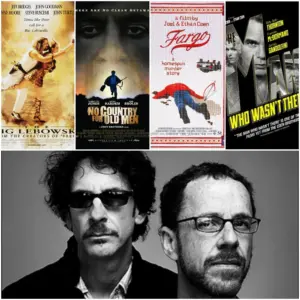 Fargo (1996) crystallizes this: the flat, snow-blinded landscapes of Minnesota photographed by Roger Deakins in compositions that feel almost geometrically serene while depicting escalating brutality. The film’s famous opening card – “This is a true story” – is itself a piece of narrative irony. Nothing is true. Everything is constructed. The Coens are telling you this while simultaneously making you believe it.
No Country for Old Men (2007) represents their darkest formal achievement. Anton Chigurh, as played by Javier Bardem, is less a character than an argument: the argument that moral frameworks are insufficient against entropy. The film famously refuses its climax – the final confrontation between Chigurh and Moss occurs offscreen. In conventional filmmaking, this would be a failure. In the Coens’ grammar, it is the meaning. Narrative resolution is a lie we tell ourselves.
The Big Lebowski (1998), meanwhile, operates as their most gleefully self-aware exercise: a Raymond Chandler mystery transplanted into 1991 Los Angeles, with a protagonist constitutionally incapable of solving anything. The film’s cult status rests on its refusal of consequence – in a genre defined by stakes, the Dude simply ambles, drinks White Russians, and bowls.
What They Changed
The Coens demonstrated that genre was a vocabulary, not a destiny. They legitimized the idea of cinema that comments on its own conventions while deploying them – meta-filmmaking not as postmodern indulgence but as a mode of serious inquiry. They trained a generation of filmmakers to ask: what does this genre assume? And what happens if I refuse that assumption?
Part II: Quentin Tarantino – Cinema as Total Environment
Where the Coens were archaeologists, Tarantino is a collagist. His films are constructed from fragments of cinema history – spaghetti westerns, blaxploitation, Hong Kong action, Italian giallo, Japanese samurai films – assembled into structures that feel simultaneously referential and wholly original. He is perhaps the most purely cinephilic filmmaker who has ever worked at scale, and his stylistic impact has been enormous precisely because his influences are so wide and his synthesis so personal.
The Stylistic Signature
Tarantino’s primary formal intervention is the restructuring of time. Pulp Fiction (1994) is the defining document: three interlocking stories told non-chronologically, so that the audience must constantly recalibrate its understanding of causality. The opening diner robbery that closes the film feels different than it did at the beginning – charged with information the first viewing hadn’t provided. This is not merely a structural trick. It is an argument about how experience works: we understand events not as they happen but in retrospect, and retrospect changes everything.
His dialogue is a second formal invention. In most Hollywood cinema, dialogue serves plot – it moves characters toward events. In Tarantino, dialogue is the event. The conversations about foot massages and McDonald’s in Pulp Fiction, the standoff discussions in The Hateful Eight, the breakfast table scene in Reservoir Dogs – these are extended set-pieces given the same weight as action sequences. He treats talking as choreography.
Kill Bill Vol. 1 (2003) and Vol. 2 (2004) demonstrate his genre-synthesis at its most spectacular: a revenge narrative that migrates through anime, Shaw Brothers kung fu, spaghetti western, and arthouse cinema within a single arc. The formal register shifts with each section – 2.35:1 anamorphic widescreen to black and white to animation – and yet the emotional throughline never fractures. This is virtuoso tonal architecture.
Django Unchained (2012) and Inglourious Basterds (2009) reveal his most politically charged use of genre: revisionist history deployed as wish fulfillment, as moral inversion. By rewriting the endings of slavery and the Holocaust through genre conventions – the Western, the war film – he forces audiences to confront both the history and the fantasy of retributive justice. The genre itself becomes the site of ethical argument.
What He Changed
Tarantino’s impact on mainstream cinema is so pervasive it is almost invisible: the non-linear structure, the self-conscious pop culture dialogue, the elevation of genre film to serious critical discourse, the long dialogue set-piece as action equivalent. He also, crucially, returned commercial cinema to the idea that films could be about cinema – that self-reference was not a weakness but a form of love.
Part III: The Second Wave – Interiority, Fracture, and Global Modernism
Darren Aronofsky – The Body in Revolt
Aronofsky’s cinema is defined by one proposition: the human body is the site where psychology becomes visible. His films externalize interiority through form — camera movement, editing rhythm, sound design — so that subjective experience becomes an almost physical assault on the viewer.
Requiem for a Dream (2000) remains his most formally extreme work. The “hip-hop montage” — rapid cuts to close-ups of pill consumption, dilating pupils, coursing blood – creates a visceral grammar for addiction: the body overwhelmed by its own desire for relief. Ellen Burstyn’s deterioration across the film is charted through image rather than exposition. The final four-way split screen is not a stylistic flourish but an argument: these people are simultaneously isolated and locked in parallel suffering.
Black Swan (2010) applies this grammar to the creative and psychological costs of perfectionism. The gradual blurring between reality and hallucination – the scratched skin, the feathers breaking through, the mirror that moves independently — mirrors Nina’s dissolution of self into role. Aronofsky is always asking: what does it cost to become what you are trying to be?
The Whale (2022) marks a formal restraint that re contextualizes his career: a single-location chamber piece that achieves emotional devastation through performance and claustrophobic framing rather than kinetic montage. The evolution suggests that his formal excesses were always in service of intimacy — when the story demanded restraint, he found it.
Paul Thomas Anderson – American Mythology in Decomposition
PTA occupies a singular position: a filmmaker with the formal ambition of Kubrick, the emotional appetite of Cassavetes, and a subject that is quintessentially American — the mythology of self-creation and its cost.
His career divides cleanly. The early films – Boogie Nights (1997), Magnolia (1999) – are maximalist in the Altman tradition: sprawling ensemble narratives with baroque camera movements (the famous Boogie Nights Steadicam opening, the 2001: A Space Odyssey-referencing riff in Magnolia) that register the interconnectedness of lives in American social fabric. Magnolia’s rain of frogs is either madness or the Old Testament – Anderson refuses to adjudicate.
There Will Be Blood (2007) is his masterwork and his formal shift. The film opens with nearly fifteen minutes of silence, Daniel Plainview alone in the desert prospecting by hand. The score by Jonny Greenwood — dissonant strings, percussion that feels geological – creates an atmosphere of primordial violence. Daniel Day-Lewis’s performance is calibrated to the film’s argument: American capitalism is a religion, and its god is a psychopath.
The Master (2012) operates as a companion piece: another patriarch, another system of belief, the same bottomless pit at the center of male American self-invention. The 65mm photography by Mihai Mălaimare Jr. gives the film a textural density – faces fill the frame like landscapes – that implicates the viewer in the intimacy it depicts.
Phantom Thread (2017) is perhaps his most elegant formal achievement: a psychological power drama rendered as pure surface, fabric and obsession and control systems encoded in every frame composition. It marks his arrival at a cinema of pure implication, where meaning lives entirely in what is withheld.
Chloé Zhao – The Landscape as Character
Zhao represents a fundamentally different cinematic philosophy: the fiction-documentary hybrid as a way of accessing truth that studio filmmaking cannot reach. Her method is to work with non-professional or semi-professional actors in actual locations, allowing the environment to generate the film’s emotional texture.
The Rider (2017) — shot on location in the Pine Ridge Reservation in South Dakota with Brady Jandreau playing a version of himself — achieves something extraordinary: the film cannot be faked, because the landscape and the person are real, and their relationship precedes the camera. Zhao’s formal contribution is the understanding that authenticity is itself a cinematographic resource.
Nomadland (2020), her global breakthrough, extends this method: Frances McDormand embedded in actual nomadic communities, real van-dwellers playing themselves, grief and freedom inseparable in the Nevada and Arizona light. The film’s visual rhythm is governed by natural light — sunrises, dusks, the particular quality of Western American space — rather than by studio construction.
Her move to Eternals (2021) within the Marvel infrastructure revealed the tension between her method and industrial filmmaking, but also demonstrated that a genuine auteur sensibility can assert itself even within highly constrained commercial environments.
Yorgos Lanthimos — Social Ritual as Absurdist Architecture
Lanthimos has constructed one of contemporary cinema’s most distinctive vocabularies: a deadpan formalism applied to the dissection of social institutions — family, courtship, power, competition — so that familiar rituals appear alien and therefore visible.
Dogtooth (2009) isolates a family in a compound where language has been systematically redefined by the parents: the word “sea” means a particular armchair, the word “zombie” means a small yellow flower. The film’s argument is that language is power, and whoever controls naming controls reality. Shot in flat, clinical compositions that mirror the family’s claustrophobia, it is one of the most formally precise films of the century.
 1.The Lobster (2015) extends this to the social institution of romantic partnership: in a near-future society, single people must find a mate within 45 days or be transformed into an animal of their choosing. The premise is absurdist, but the film’s flat affect and deadpan performance register make it feel like a documentary about contemporary dating culture. Lanthimos’s formal signature — the wide shot that isolates characters in institutional spaces, the performance style that strips emotional signaling down to near-nothing — creates a dissonance that generates dark comedy and genuine unease simultaneously.
Poor Things (2023) represents his most baroque formal statement: a Frankenstein narrative set in a retro-futurist Victorian world, shot with a fisheye lens that distorts architecture and bodies alike, in a color palette that migrates from desaturated black and white to violent color saturation as protagonist Bella’s consciousness expands. It is Lanthimos’s argument for liberation through the body — and his most affirmative statement.
Denis Villeneuve — The Cinema of Scale as Philosophical Inquiry
Villeneuve has become the foremost practitioner of what might be called the “monumental question” film: science fiction and thriller deployed not for spectacle but for genuine epistemological investigation. His visual language is defined by the relationship between the human figure and vast, incomprehensible space.
Arrival (2016) is his defining statement: contact with an alien intelligence as a framework for examining the relationship between language, time, and consciousness. The heptapod visual language — circular, non-sequential — is not merely production design. It is the film’s argument made visible. If your language is non-linear, your experience of causality is non-linear. Villeneuve and cinematographer Bradford Young construct a color palette — grey-green, desaturated, perpetually overcast — that feels like the visual equivalent of a question that has no comfortable answer.
 Dune: Part One (2021) and Part Two (2024) represent his most ambitious formal project: rendering Frank Herbert’s novel not as adventure but as a meditation on the danger of the messiah myth. The Arrakis sequences — shot in Jordan and Abu Dhabi — achieve a visual immensity that makes the human characters appear almost incidental, insects against geological time.
Anurag Kashyap — The Violence Beneath the Surface of India
Kashyap is perhaps the most formally brave filmmaker in contemporary Indian cinema — not because he works against Bollywood conventions, but because he transforms them. His films use the materials of popular Hindi cinema (melodrama, songs, male camaraderie) and subject them to a realist pressure that exposes their mythological function.
Gangs of Wasseypur (2012, Parts I & II) is his magnum opus: a five-hour crime epic spanning three generations of a Jharkhand coal-belt family, structured as a Godfather-esque saga but shot with a documentary immediacy — handheld camera, naturalistic sound, authentic location work — that feels nothing like Hollywood gangster mythology. The songs are not escapist interludes but social documents; the violence is not aestheticized but mundane and therefore more disturbing.
Black Friday (2004) – his 1993 Bombay bombings reconstruction — established his method: a mosaic of perspectives, no privileged protagonist, the event reconstructed through multiple partial visions. It is essentially a political film about the impossibility of single-perspective truth-telling.
His formal signature across films is the refusal of catharsis: characters die at unexpected moments, moral frameworks collapse without resolution, structural closure is withheld. This is not nihilism but realism — an insistence that Indian social reality does not offer the neat narrative resolution that Bollywood has historically promised.
Ram Gopal Varma — Disruption as Method
Varma’s contribution to Indian cinema is primarily structural: he imported the visual grammar of American independent filmmaking — low angles, unconventional framing, aggressive sound design — into the Bollywood ecosystem of the 1990s, when such choices were genuinely radical.
Satya (1998) is his foundational work: Mumbai underworld crime rendered with a handheld, almost neo-realist intimacy that contrasted sharply with the glamorized gangster mythology of contemporary Hindi films. The city itself became a character — cramped chawls, night-lit streets, the geography of social pressure that produces crime.
Company (2002) and Sarkar (2005) demonstrate his continued preoccupation with power systems and their internal logic. His influence is embedded in the generation of Indian directors who followed — Kashyap among them – who inherited his insistence that Indian cinema could be formally experimental without being commercially marginal.
His trajectory has been uneven, but his disruption of the house style of Hindi cinema in the late 1990s was genuinely catalytic.
S.S. Rajamouli – The Grammar of Epic Restored
Rajamouli operates in the opposite formal register from the directors above: rather than deconstruction, he practices maximalist synthesis. His cinema seeks to recover the mythological scale and emotional directness of classical epic tradition – not ironically, but with complete conviction.
Baahubali: The Beginning (2015) and Baahubali 2: The Conclusion (2017) are the defining texts: a fantasy epic rooted in Indian mythological tradition (the Mahabharata’s dynamics of rightful kingship, sacrifice, and revenge) executed with a production scale that rivaled Hollywood’s most ambitious blockbusters. The films’ visual language draws on everything from Kurosawa’s compositional grammar to Peter Jackson’s battle choreography to the theatrical traditions of Kuchipudi and classical Carnatic performance.
RRR (2022) achieved global breakthrough by pairing the mythological-scale action with a buddy dynamic of irresistible emotional directness, deploying song and dance as narrative climax rather than interruption. The “Naatu Naatu” sequence is not a musical interlude — it is the film’s central statement of joy as political defiance.
Rajamouli’s formal contribution is the demonstration that the grammar of spectacle need not be American or European — that Indian mythological traditions contain their own visual and narrative logic, and that cinema deployed within that logic can achieve global resonance without cultural translation.
Part IV: The Next Generation Cinema — What Comes After Deconstruction
Having traced this lineage, we can identify the fault lines along which the next generation of cinema is likely to form. Several emerging tendencies are already visible.
1. The Collapse of the Fiction-Documentary Border
The most productive formal territory in contemporary cinema is the space between scripted fiction and documentary record. Zhao established this as a viable prestige mode, but the next generation will likely push it further — toward what might be called participatory realism: films in which the subjects have genuine creative agency over their representation, where the boundary between filmmaker and filmed continues to dissolve. AI-assisted production tools will paradoxically accelerate this: as generated imagery becomes cheaper, the value of genuine documentary reality will increase.
2. Non-Linear and Networked Narrative Structures
The Coens and Tarantino demonstrated that time could be restructured within a single film. The next move is likely toward networked narratives: films (or film-like objects) that exist across multiple platforms simultaneously, where the sequence of consumption is partly viewer-determined. This is not merely a marketing strategy but a formal possibility — the meaning changes depending on which story thread you follow first.
3. The Return of the Body and the Sensory
After decades of cinema increasingly oriented toward the conceptual – the idea of a film as argument — there is growing evidence of a counter-tendency: cinema that reasserts the pre-rational, somatic impact of image and sound. The success of directors like the RRR-era Rajamouli, the late Denis Villeneuve, and the growing visibility of Southeast and South Asian action cinema suggests an appetite for the visceral that the ironic, deconstructive tradition cannot satisfy. The next great cinema may be one that is intellectually rigorous and emotionally overwhelming simultaneously.
4. Global South as Formal Center
For most of cinema history, formal innovation has traveled from West to East and North to South — Hollywood and European art cinema establishing the grammar that “world cinema” worked within or against. This is no longer accurate. The formal innovations emerging from South Korean cinema (Bong Joon-ho’s genre hybrids), Indian regional cinema (Malayalam’s naturalist revolution, Tamil’s action stylistics), Nigerian Nollywood’s accelerated production model, and Latin American magical realist cinema suggest that the center of formal experimentation has genuinely pluralized. The next generation’s defining filmmakers are as likely to come from Lagos, Chennai, or Buenos Aires as from New York or Paris.
5. AI as Material, Not Replacement
The most urgent formal question facing the next generation is the relationship between human filmmaking and AI-generated imagery. The reactionary response – rejection – is as creatively uninteresting as the naive response — wholesale adoption. The productive territory is treatment of AI-generated imagery as a new material with its own properties, as filmmakers once learned to treat color, or sound, or digital video. Directors who understand what AI imagery does well (scale, impossible continuity, stylistic mimicry) and what it does poorly (genuine surprise, the photographic accident, the face of a real person in a real place) will develop a formal vocabulary that is neither purely analog nor purely generated.
6. Intimacy as Resistance
In an era of increasing spectacular scale – both in Hollywood and in the global blockbuster traditions exemplified by Rajamouli – there is a countercurrent moving toward radical intimacy. The chamber film, the two-character study, the film that derives its power entirely from performance and dialogue rather than visual event — this mode is far from exhausted. As production costs for spectacle collapse with AI and virtual production, the economic rationale for intimacy-over-scale changes. What remains constant is the human hunger for close attention to a single face.
Part V: The Overlooked Hemispheres – Cinema That Rewrote the Map
The directors discussed in Parts I through III are not the whole story of formal innovation in global cinema over the last three decades. They are the filmmakers who received maximum critical infrastructure — Western festival circuits, Academy recognition, prestige distribution, the canonizing machinery of Anglo-American film journalism. But cinema’s most radical formal experiments have often occurred in spaces that apparatus couldn’t fully see. To understand where cinema is going, we need to account for what the dominant critical discourse undervalued.
The Korean Wave Before It Was a Wave: Park Chan-wook, Bong Joon-ho, and the Logic of Genre Betrayal
South Korean cinema produced, between 1999 and 2019, arguably the most sustained body of formally innovative genre filmmaking in world cinema. The context matters: the Korean film industry had been protected from American imports by a domestic screen quota system, forcing Korean studios to develop a local commercial grammar rather than simply replicate Hollywood. When that grammar collided with a generation of filmmakers trained on European art cinema and American genre films simultaneously, the result was an aesthetic that couldn’t easily be classified.
Bong Joon-ho’s Memories of Murder (2003) is the defining early document: a serial killer procedural set in 1980s rural Korea, in which the expected genre catharsis – the killer identified, justice delivered — is systematically withheld. The film ends with the detective looking directly into the camera, the killer never found, the genre promise deliberately broken. What Bong understood — and what his Hollywood counterparts rarely managed — was that genre conventions encode social assumptions, and breaking the convention exposes the assumption. In South Korea of the 1980s, under military dictatorship, the assumption was that authority was capable of justice. It wasn’t. The film’s formal refusal is a political statement.
Parasite (2019) extended this to global scale: a class analysis conducted through the mechanics of a home invasion thriller, where the genre’s traditional moral alignment – the house, order, propriety versus the intruder, chaos, threat — is systematically inverted and then reinverted until no stable moral position remains. The shift from the sun-drenched comedy of the film’s first half to the rain-flooded violence of its second is one of the most precisely managed tonal pivots in contemporary cinema, and it enacts the film’s argument rather than merely illustrating it: class violence doesn’t announce itself. It arrives suddenly, in the dark.
Park Chan-wook’s Oldboy (2003) operates in a different register: Greek tragedy assembled from the materials of pulp revenge cinema. The film’s famous corridor fight — a single extended shot of exhausted, semi-competent violence that deliberately parodies action movie choreography — is perhaps the most formally intelligent action sequence of its decade. Real violence is not balletic. It is grinding, desperate, and ugly. Park spent the scene making this argument.
What the Korean New Wave demonstrated, rationally, is that genre cinema and art cinema are not opposing categories but a spectrum – and that the most powerful work happens when filmmakers understand genre well enough to know exactly which conventions to break and why.
Iranian Cinema and the Grammar of Constraint
Iranian cinema occupies a unique formal position: a national cinema that developed an internationally significant aesthetic partly because of censorship rather than despite it. The Islamic Republic’s restrictions on what could be depicted – women without hijab, physical contact between unrelated men and women, direct political commentary – forced filmmakers to develop a grammar of implication, ellipsis, and indirection that turned out to be extraordinarily powerful.
Abbas Kiarostami’s Close-Up (1990) is the foundational text: a documentary-fiction hybrid about a man who impersonated director Mohsen Makhmalbaf to gain access to a middle-class Tehran family, constructed from actual court proceedings, reenactments, and footage of the real people involved. The film is formally recursive — it is a film about a man obsessed with cinema being filmed by a filmmaker who is himself examining that obsession — but its emotional impact comes from something simpler: the genuine desperation of a poor man who wanted to be taken seriously, filmed with complete respect. Kiarostami demonstrated that the border between document and fiction was not a problem to be solved but a territory to be inhabited.
Asghar Farhadi’s A Separation (2011) extended the Iranian tradition into the moral thriller: a marital dissolution that generates a legal crisis, in which every character is simultaneously right and wrong, sympathetic and culpable. The film never offers a verdict – on the central legal question or on any of the human questions the legal question illuminates. Its formal achievement is the construction of a narrative machine that generates genuine moral uncertainty rather than the simulacrum of it that most legal thrillers provide.
The rational lesson of Iranian cinema is this: constraint is not the enemy of formal innovation. Often it is the condition of it. Filmmakers who must imply rather than show, who cannot access the easy vocabulary of explicit content or direct statement, develop muscles that unconstrained filmmakers rarely need.
Romanian New Wave and the Long Take as Political Technology
The Romanian New Wave emerged in the mid-2000s as one of the most formally coherent national cinema movements of its generation. Its central formal device – the long take, often in real time, often in a single location — was not chosen for aesthetic reasons alone. It was chosen because of what it cannot hide.
Cristian Mungiu’s 4 Months, 3 Weeks and 2 Days (2007) contains what may be the most formally devastating single shot in contemporary European cinema: Otilia sitting at a dinner table with her boyfriend’s family, surrounded by their mundane conversation about food and work, while the camera holds in a fixed medium shot for approximately six minutes. Elsewhere in the city, her friend is alone with a man who is performing an illegal abortion. The dinner table scene is torture not because anything terrible is happening within it, but because of what it refuses to cut to. The long take here is an ethical position: Mungiu will not give the audience the relief of cutting to the abortion scene. He forces us to sit with Otilia’s helplessness.
Corneliu Porumboiu’s 12:08 East of Bucharest (2006) – about a television program trying to determine whether their small town had its own revolutionary moment in December 1989 – uses a single television studio set and two cameras for most of its running time, generating comedy and melancholy from the same image: people trying to determine whether history had touched them, and finding no clear answer.
The Romanian filmmakers demonstrated that the long take was not merely an aesthetic preference but a truth technology. When you cannot cut, you cannot hide. The performance cannot rely on editing to construct its meaning. The environment becomes responsible. The viewer cannot be manipulated by rhythm in the same way.
Japanese Cinema After the New Wave: Kore-eda Hirokazu and the Ethics of Observation Kore-eda Hirokazu’s formal method stands in conscious relationship to the documentary tradition — specifically to the Japanese documentary filmmaker Kazuo Hara, whose confrontational approach Kore-eda explicitly rejected in favor of something he described as observation without judgment.
Nobody Knows (2004) follows four children abandoned in a Tokyo apartment by their mother, a film based on an actual 1988 case. Kore-eda shot it over nearly a year, filming with the actual child actors across the seasons so that the temporal passage registered in their bodies rather than in makeup and production design. The eldest child grows visibly during the film. This is not a directorial choice — it is a consequence of his method: patient, long-duration observation.
Shoplifters (2018) deploys the same patience in the service of a more complex moral architecture: a found family of petty criminals who take in an abused child, a narrative that forces the viewer to continuously recalibrate the ethics of the central act. Is taking a child from abusive parents theft or rescue? Is a family constructed from need and mutual affection less real than a family constructed from biology and law? Kore-eda asks these questions formally – through the unhurried rhythm of domestic scenes, meals, sleep, small kindnesses — rather than rhetorically.
His formal contribution is the proposition that cinema’s ethical dimension is not primarily located in its content — what the film is about – but in its mode of attention. How a camera relates to its subject is already a moral position, prior to anything the subject does.
Latin American Cinema: Magical Realism, Political Trauma, and the Limits of Genre
Latin American cinema has maintained a formal tradition – rooted in literary magical realism and in the specific experience of postcolonial political violence – that has no precise equivalent elsewhere. The violence that haunts Latin American cinema is not the genre violence of American film or the ethnic conflict violence of some African and Asian cinema. It is bureaucratic, disappearing, state-administered — violence that erases rather than destroys, that denies its own existence.
Lucrecia Martel’s La Ciénaga (2001) establishes her as the most formally rigorous Latin American filmmaker of her generation. The film observes a wealthy Argentine family in slow disintegration at their crumbling country estate. There is almost no plot in the conventional sense. What Martel tracks instead is the texture of a class in the process of losing its rationale — the leisure that no longer functions as pleasure, the servants whose labor sustains a way of life that doesn’t know it’s already over. Her sound design is as precise as her image-making: off-screen sounds that refuse to be explained, conversations that begin and end without resolution, the acoustic texture of entitled existence.
Alfonso Cuarón’s Roma (2018) represents a different engagement with Latin American social structure: a Mexican filmmaker deploying the most technically advanced filmmaking tools available (digital 65mm, extensive long takes, precisely orchestrated crowd choreography) in the service of a personal memoir about his childhood housekeeper — a woman to whom his class position denied full personhood. The film’s formal beauty is in constant tension with its subject’s social invisibility, and this tension is the film’s meaning: we are seeing, for the first time and at maximum resolution, someone who was designed by social structure not to be seen.
Guillermo del Toro’s work operates in a related register but a different emotional key: he uses fantasy and the Gothic tradition to metabolize specifically Latin American experiences of political terror. Pan’s Labyrinth (2006) does not use fantasy to escape from the reality of post-Civil War Fascist Spain — it uses fantasy to survive it, the way traumatized children actually do. The Faun’s world is not the opposite of Vidal’s world. It is the response to it.
African Cinema and the Burden of Representation
African cinema operates under a formal constraint that has no real parallel elsewhere: the weight of representation. When a French filmmaker makes a bad film, it is a bad film about France. When a Senegalese filmmaker makes a film, it is frequently received as a film about Africa — the entire continent, all fifty-four nations, compressed into a single vision. This burden has shaped African cinema’s formal strategies in ways that are worth examining honestly.
Ousmane Sembène — the father of African cinema, working from the 1960s onward — addressed this burden directly by insisting on specificity: his films were about Dakar, about Wolof social structure, about the particular class dynamics of Senegalese post-independence society. He refused the generalizing pressure of Western reception by making films too specific to be comfortably consumed as representative African stories.
The contemporary Nollywood phenomenon represents a different response: the construction of a genuinely mass cinema that serves its own audience first and is not addressed to the Western gaze at all. Nollywood’s formal qualities – rapid production schedules, melodramatic emotional registers, video aesthetics rather than film aesthetics – have been extensively analyzed by Western critics, usually in terms of what they lack. This is the wrong framework. Nollywood is the most-watched cinema in Africa. It developed in response to African audience desire, not Western critical criteria. Its formal qualities are features, not bugs.
The more interesting formal question is what happens when African filmmakers trained in Western film culture return to work in African contexts. Directors like Mahamat-Saleh Haroun (Chad) and Mati Diop (Senegal-France) navigate this with evident self-consciousness: their films bear the traces of European art cinema training while addressing African social realities that European cinema cannot fully see.
Part VI: The Rational Anatomy of Style Change — Why Cinema Shifts When It Does
Having surveyed the global field, we are in a position to make a structural argument rather than merely cataloguing individual directors. Why does cinematic style change when it does? What are the actual mechanisms? The standard account – genius directors innovate, lesser directors follow — is insufficient. Style change in cinema is systemic, and understanding the system is more useful than celebrating the individuals.
Mechanism 1: Technology Changes What Is Possible, Which Changes What Is Necessary
The relationship between technology and cinematic style is not deterministic but it is real. When lightweight cameras became available in the late 1950s and early 1960s, they did not automatically produce the French New Wave — but they made it possible. When digital video became economically viable in the late 1990s, it did not automatically produce Dogme 95 – but it enabled it. When digital color grading became standard, it did not automatically produce the teal-and-orange aesthetic that dominated 2000s Hollywood — but it made that aesthetic seductively easy to achieve.
The current technological disruption – AI-generated imagery, virtual production environments, real-time rendering — is not simply a matter of production efficiency. It changes what is scarce and what is abundant. Scale becomes cheap. Location becomes optional. The face of a deceased actor becomes available. These changes will produce formal responses that we cannot fully predict, but the logic is consistent: when a resource that was once expensive becomes cheap, it loses its expressive power. When it was hard to put a hundred warriors on screen, a hundred warriors meant something. When it is free to put a million warriors on screen, a million warriors means nothing.
The formal corollary: the next generation of cinematically powerful choices will be made in the domain of what cannot be generated. Genuine human performance. The uncontrolled environment. The face that ages in real time. These become more valuable, not less, as their opposites become more available.
Mechanism 2: Political and Social Conditions Generate Formal Demands
This is the mechanism that cinema criticism most often underestimates. Cinematic form is not developed in aesthetic isolation — it is developed in response to what the existing formal vocabulary cannot say.
The French New Wave did not emerge because Truffaut, Godard, and Chabrol were bored with classical Hollywood. It emerged because postwar France needed a cinema that could address the ambiguities of the Occupation, the Algeria question, the experience of a generation that had grown up in collaboration and defeat. Classical Hollywood narrative resolution — the clear moral, the earned ending — was aesthetically inappropriate for this material. Non-resolution, fragmentation, irresolution: these were not stylistic preferences. They were formal necessities.
The Iranian cinema of constraint discussed above is another instance: the censorship regime produced an aesthetic of implication that turned out to be formally sophisticated in ways that unconstrained cinema rarely achieves.
Contemporary Indian regional cinema — specifically the Malayalam cinema of the 2010s and 2020s — has developed a naturalist aesthetic rooted in the social reality of Kerala: its high literacy, its leftist political tradition, its specific caste and religious dynamics. Films like Drishyam (Jeethu Joseph, 2013), Kumbalangi Nights (Madhu C. Narayanan, 2019), and the work of Lijo Jose Pellissery are formally distinct from both Bollywood and from Hollywood not because their filmmakers are simply more talented, but because the social reality they are addressing requires a different grammar.
The rational argument: style change accelerates when social conditions change faster than the existing formal vocabulary can process them. The 2010s and 2020s have been a period of accelerated social change globally — digital disruption, pandemic, political polarization, the renegotiation of gender and identity. The cinema that will matter formally in the next decade is the cinema that develops the vocabulary to address this reality with genuine specificity.
Mechanism 3: The Economics of Cinema Shape Its Aesthetics
The relationship between money and form in cinema is taboo in most critical discourse. Directors don’t like to admit that their aesthetic choices are shaped by budget, and critics find it reductive to say so. But the evidence is overwhelming.
The independent American cinema of the 1990s — Linklater, Hartley, Jarmusch, early Soderbergh — developed its aesthetic of long takes, location shooting, and non-professional performance partly because these directors had no money for anything else. The aesthetic that emerged from constraint was later recognized as a virtue and consciously replicated by directors who could afford to do otherwise.
The inverse is also true. The Marvel Cinematic Universe’s aesthetic — which now defines the look of mainstream global cinema perhaps more than any single director does — is the aesthetic of unlimited money deployed without formal vision. Unlimited visual effects without a governing aesthetic philosophy produce not richness but noise.
The rise of streaming economics is producing formal changes that are still working themselves out. Netflix and its competitors fund films and series from a global range of territories, but they do so with audience retention metrics that shape content in ways editorial boards never quite did. The data shows that international audiences skip foreign-language dialogue-heavy sequences. This creates an economic incentive toward action, visual spectacle, and plot-driven momentum regardless of the filmmaker’s own aesthetic preferences. The formal consequence is a gradual convergence: global cinema is beginning to look more similar, not less, as global distribution becomes more available.
The counter-force is cost: intimate, dialogue-driven, location-specific cinema is cheap to produce and has been repeatedly demonstrated to find global audiences when given distribution. The formal challenge for the next generation is developing economic models that sustain genuine formal ambition without surrendering to the metrics of the streaming era.
Mechanism 4: Cross-Cultural Contamination as Creative Engine
The most underappreciated mechanism of cinematic style change is the cross-cultural encounter — the moment when a filmmaker from one tradition encounters the grammar of another and produces a synthesis that neither tradition could have generated alone.
Akira Kurosawa’s encounter with John Ford produced Seven Samurai (1954) – and then Ford’s encounter with Seven Samurai produced The Magnificent Seven (1960), and then Leone’s encounter with both produced A Fistful of Dollars (1964), which Tarantino then fed into Django Unchained. The genealogy of a single formal tradition spanning sixty years and three continents.
Rajamouli’s work is a contemporary instance of this contamination: his cinema is saturated with Kurosawa’s compositional grammar, Peter Jackson’s battle choreography, the emotional directness of classical Telugu stage tradition, and the stunt aesthetics of Jackie Chan’s Hong Kong action period — processed through a sensibility that is irreducibly Telugu in its mythological framework and emotional register. The result is not a hybrid in the sense of something between traditions. It is a synthesis that generates a new grammar.
The next generation’s most formally interesting filmmakers will likely be those who have access to the widest range of cinematic traditions and the clarity to know which elements from each tradition serve the truth they are trying to tell.
Part VII: The Specific Conditions of Indian Cinema – Why It Is Both Ahead and Behind
India presents a unique case in global cinema history, worth examining with particular analytical honesty. It is simultaneously one of the most prolific film industries in the world (producing over 1,500 films annually across languages), the source of some of the most formally innovative cinema of the last three decades, and a context in which formal innovation has historically been structurally penalized by commercial economics.
The Language Plurality Problem and Its Formal Consequences
Indian cinema is not one cinema. It is at minimum eight distinct industrial and aesthetic traditions — Hindi (Bollywood), Tamil, Telugu, Malayalam, Kannada, Bengali, Marathi, Punjabi — each with its own genre conventions, star systems, audience expectations, and formal norms. The assumption that “Indian cinema” is equivalent to “Bollywood” has distorted critical analysis of the field for decades, particularly in Western reception.
Malayalam cinema’s recent international visibility – films like Jallikattu (Lijo Jose Pellissery, 2019), The Great Indian Kitchen (Jeo Baby, 2021), and Joji (Dileesh Pothan, 2021) — represents not a sudden flowering of talent but the belated recognition of a tradition that has been developing formal sophistication for decades, in a state with high literacy, strong literary culture, and an audience willing to sit with complexity.
Tamil cinema’s genre ecology – with its own action conventions, its musical traditions, its specific treatment of masculinity rooted in Dravidian cultural frameworks — has produced directors like Mani Ratnam (whose formal command of song-as-narrative climax predates and arguably exceeds Rajamouli’s deployment of the same tool) and Pa. Ranjith (whose Kabali and Kaala use the Rajinikanth star persona as a vehicle for explicit Dalit political cinema).
The rational argument about Indian cinema is this: the formal diversity of Indian language cinemas is not a problem of fragmentation but a resource. The next significant Indian filmmaker is likely to emerge from this plurality – from the cross-contamination between Malayalam naturalism, Tamil genre sophistication, Telugu mythological scale, and the increasingly international training of a new generation of Indian directors.
The OTT Revolution and Indian Cinema’s Formal Consequences
The arrival of Netflix, Amazon Prime, and their Indian competitors – ZEE5, SonyLIV, Disney+ Hotstar – has done something structurally unprecedented: it has created a viable distribution infrastructure for Indian-language cinema that doesn’t require either the theatrical revenue of a commercial hit or the critical infrastructure of the festival circuit. A Malayalam film with a budget of ₹5 crore can now reach thirty million viewers.
The formal consequence is already visible: the Malayalam naturalist tradition has expanded dramatically, producing work that would previously have been commercially unviable. The OTT context has also produced a new narrative form — the limited series, particularly the crime and thriller genre — that has imported prestige television’s structural vocabulary (multi-episode character development, season-long narrative arcs) into an Indian context where it has hybridized with local storytelling traditions.
Delhi Crime (2019) is an early instance: a seven-episode series about the investigation of the 2012 Delhi gang rape, structured with the procedural grammar of an American crime series but embedded in a specifically Indian institutional context — the exhaustion and improvisation of Delhi Police bureaucracy, the class dynamics between the investigating officers, the moral weight of an event that triggered a national reckoning. Its formal success rests on the fit between the imported genre and the local material: the procedural is the right grammar for institutional investigation.
The Bollywood Crisis and What It Means
The commercial Hindi film industry has been in structural crisis since approximately 2020 – a convergence of pandemic disruption, OTT competition, and a growing audience resistance to the industry’s formulaic output. The box office failures of a series of expensive star vehicles in 2022 and 2023 were widely interpreted as a star power crisis. The rational analysis is different: they were a content crisis. Audiences had developed more sophisticated taste through exposure to global content on OTT platforms, and the standard Bollywood formal vocabulary — the masala film’s combination of romance, action, comedy, and sentiment in specific proportions — was no longer automatically satisfying it.
The films that succeeded in this environment – The Kashmir Files (2022), Pathaan (2023), Animal (2023) — did so by maximizing specific emotional registers rather than balancing them. The masala formula is a diversified portfolio. These films were concentrated bets: maximum outrage, maximum spectacle, maximum transgression. Formally, this is not sophistication — it is the intensification of existing vocabulary rather than its renewal. What Bollywood has not yet produced in this cycle is a filmmaker who responds to the crisis with a formal innovation rather than a tonal amplification.
That filmmaker exists. The question is whether the commercial infrastructure will support them when they arrive.
Part VIII: Cinema at the Edge of Its Own Definition
There is a deeper question that the historical survey above forces us to confront: cinema is no longer a clearly bounded art form. It was, for most of its history, defined by a specific set of conditions — a projector, a screen, a darkened room, a fixed duration, an audience that had gathered in a specific place. These conditions are now optional rather than necessary. The majority of the global audience watches cinema on personal screens, in daylight, with frequent pauses, often simultaneously with other activity. The question of what this does to cinema as a formal project is not being asked loudly enough.
The Attention Economy and the Formal Response
 The attention economy analysis of cinema goes roughly as follows: streaming platforms train audiences toward shorter attention spans by making the next episode immediately available, by providing automatic playback, by generating an endless queue of alternatives. The result is a formal pressure toward faster editing rhythms, front-loaded narrative hooks, and the elimination of the contemplative register.
There is substantial evidence for this as a description of mainstream streaming content. But the countervailing evidence is equally striking: the continued global success of slow cinema – Kore-eda, Mungiu, Zhao – in exactly the streaming environment that allegedly cannot sustain it. Drive My Car (Ryusuke Hamaguchi, 2021), a three-hour Japanese film in which an actor processes grief while driving a Saab 900 to rehearsals of a Chekhov play, won the Academy Award for Best International Feature Film in 2022 and found a substantial global audience on MUBI. Jeanne Dielman, 23 quai du Commerce, 1080 Bruxelles (Chantal Akerman, 1975) – a three-hour-twenty-minute film about a housewife’s daily routine — was voted the greatest film of all time by Sight & Sound magazine in 2022. Neither of these facts is consistent with the death-of-slow-cinema narrative.
The rational conclusion: attention is not uniformly short. Audiences calibrate their attention to what the experience demands. A film that earns slow attention can hold it. The formal challenge is not to match the rhythm of distraction but to create the conditions under which genuine attention is possible.
The Festival Circuit as Taste Infrastructure – Its Power and Its Limits
The international film festival circuit – Cannes, Venice, Berlin, Toronto, Sundance, and their second-tier equivalents – functions as the primary taste infrastructure for prestige global cinema. It determines which films receive critical attention, distribution deals, and the awards recognition that drives prestige marketing. Its influence on which filmmakers are canonized as auteurs is enormous.
The circuit’s biases are worth naming directly. It has historically overvalued certain formal qualities — long takes, slow pacing, emotional restraint, elliptical narrative – and undervalued others — emotional directness, genre conventions, popular entertainment. It has historically rewarded cinema from certain national contexts over others, reflecting the cultural politics of its founding institutions (European, specifically French).
The festival circuit’s canonization of directors like Kiarostami, Tarkovsky, and Bergman while largely ignoring Rajamouli until RRR’s global breakthrough is not a neutral aesthetic judgment. It reflects a set of assumptions about what cinema is for — introspection, not spectacle; individual psychology, not collective mythology; ambiguity, not resolution. These are not universal values. They are the specific values of a specific cultural tradition, and they have been enforced globally through the festival’s gate-keeping power.
The streaming era and the social media era are disrupting this gate-keeping in real time. A film like RRR can achieve global cultural status without festival recognition. A director like Jordan Peele can build a major commercial-and-critical reputation through mechanisms that have nothing to do with Cannes. The formal consequence is a genuine pluralization: cinema is no longer a single hierarchy with festival prestige at the top. It is multiple hierarchies with different criteria, and films are increasingly evaluated simultaneously against all of them.
What the Audience Knows That Critics Don’t
There is a rational argument — underrepresented in critical discourse — that mass audiences often correctly perceive formal qualities that critics misread. The dismissal of blockbuster cinema as formally empty has repeatedly been shown to be incorrect. James Cameron’s Avatar (2009) was described by significant portions of critical discourse as formally naive despite its unprecedented synthesis of digital production tools. Its sequel, Avatar: The Way of Water (2022), contains extended underwater sequences that represent a genuine formal achievement in the representation of liquid environment that no previous cinema had managed.
Christopher Nolan’s cinema – formally ambitious in its treatment of time, memory, and consciousness – has been simultaneously celebrated by mass audiences and treated with condescension by a section of prestige critical discourse that values foreign-language minimalism as inherently more serious. The condescension is not sustainable.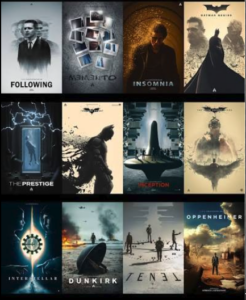
Dunkirk (2017) is a film without a conventional protagonist, with a deliberately disorienting chronological structure, whose formal choices are as deliberate as anything in European art cinema. Its commercial success does not make it formally simpler.
The mass audience is not always right. But the mass audience’s consistent gravitational pull toward certain emotional registers — the epic, the mythological, the redemptive, the transgressive — reflects something real about human experience that cinema’s most prestigious registers sometimes fail to honor. The next generation of formally significant filmmakers are likely to be those who refuse the binary between commercial and arthouse, who treat the mass audience as a sophisticated formal constraint rather than an obstacle to seriousness.
Part IX: The Next Generation – Specific Bets
The previous article’s section on next-generation cinema identified tendencies. Here we make more specific predictions, grounded in the analysis above.
The Emergence of South and Southeast Asian Genre Dominance
The formal sophistication of Indian regional cinema, combined with the economic infrastructure of OTT distribution and the global appetite for non-Hollywood genre cinema demonstrated by the Korean Wave’s success, suggests that South and Southeast Asian cinema is on the cusp of a period of global influence comparable to what Hong Kong action cinema achieved in the 1980s and 1990s.
The specific filmmakers to watch: Prashanth Neel, whose KGF series has demonstrated that Kannada-language cinema can operate at mythological scale with a distinctive visual grammar (extreme contrast, baroque art direction, a protagonist whose violence has cosmic register); Sandeep Reddy Vanga, whose Animal — despite its moral problems — demonstrates a command of transgressive escalation that is formally sophisticated even when it is ideologically troubling; the generation of Malayalam directors working in the naturalist tradition who are developing a formal vocabulary for intimate social realism that has no equivalent in current Hollywood.
Internationally, Thai cinema (Apichatpong Weerasethakul’s dream-logic formalism has been globally recognized since Uncle Boonmee Who Can Recall His Past Lives won the Palme d’Or in 2010), Vietnamese cinema, and Indonesian cinema are generating formal experiments that the global critical apparatus has not yet adequately processed.
The African Filmmaker Generation
The generation of African filmmakers now in their 30s and 40s — trained in African institutions, European film schools, and American universities simultaneously, with access to global distribution through streaming platforms — represents the most significant unrealized potential in world cinema. The formal traditions available to them are extraordinary: the oral storytelling tradition with its non-linear, multi-voice structure; the visual traditions of African textile, architecture, and ceremonial performance; the political tradition of post-independence cinema; and the contemporary global film grammar. The synthesis of these resources has not yet produced its defining filmmaker. But the conditions for that filmmaker’s emergence are better now than they have ever been.
The Reclamation of the Melodrama
Melodrama is cinema’s most consistently undervalued mode. It is the mode in which emotion is the subject rather than the result — in which the formal project is the direct representation of feeling rather than the careful construction of conditions that might produce feeling in the viewer. It was the dominant mode of classical Hollywood cinema, of Indian popular cinema, of Latin American telenovela tradition, of Korean drama. It has been systematically devalued by critical infrastructure that associates restraint with seriousness.
The next significant formal development may be the reclamation of melodrama as a sophisticated mode rather than a naive one — the recognition that the direct representation of grief, joy, rage, and love is not formally simpler than the restrained representation of these states. It is harder. The restraint is a technique for managing the risk of sentimentality. The melodramatic mode accepts that risk and tries to earn the emotion directly. When it works — in Sirkian excess, in the best of Indian musical cinema, in the emotional peaks of Rajamouli — it achieves something that no amount of formal restraint can approximate.
The Ethics of the Camera — New Questions
The next generation will inherit a cinema in which the ethics of what a camera is allowed to show, and what showing means, have been radically destabilized. The proliferation of deepfake technology makes the photographic image — long assumed to be evidence — available for fabrication. The use of AI to generate performances from deceased actors without their consent raises questions about the ontological status of the cinematic image that the art form has not previously had to confront.
These are not merely legal or industrial questions. They are formal questions. If an image of a person can be generated without that person’s presence, what does cinema’s claim to reality mean? What changes about the viewer’s relationship to the image if its authenticity is in doubt? The filmmakers who address these questions formally — rather than simply accepting generated imagery as a production tool — will produce work that is genuinely new.
The most likely formal response is the reassertion of indexicality as a value: the deliberate signaling of the real, the ungenerated, the present body in the present location. This is already visible in the work of Zhao, Kore-eda, and the Romanian New Wave. As generated imagery becomes more common, the fact of presence — the actual face of an actual person actually doing a thing in an actual place — will become more cinematically significant, not less. The photographic index will be the art form’s primary resistance to its own potential dissolution.
Conclusion: The Unfinished Grammar — A Rational Summary
Cinema is not one thing with a single history. It is a technology with global adoption that different cultures, economies, and political conditions have developed in fundamentally different directions. The error of most cinema history — including much that appears in prestige publications — is the assumption of a single evolutionary line running from the Lumière Brothers through Classical Hollywood through the European New Waves through contemporary arthouse cinema, with everything else as peripheral or belated. The rational picture is more complex and more interesting.
There are multiple formal traditions that developed in partial independence of each other, that have increasingly cross-contaminated as global distribution has expanded, and whose interaction is now the primary engine of formal innovation. The Coen Brothers and Tarantino extended a specifically American tradition of genre self-consciousness rooted in both Hollywood classicism and European modernism. The second-wave directors – Aronofsky, Anderson, Zhao, Lanthimos, Villeneuve – extended different strands of that tradition while absorbing influences from Korean, Iranian, Taiwanese, and Romanian cinema that the first wave had largely ignored. The Indian directors – Kashyap, Varma, Rajamouli – worked simultaneously within and against traditions that had no direct Western equivalent, developing formal vocabularies that Western critical infrastructure could not adequately evaluate until those vocabularies had achieved undeniable global impact.
Every filmmaker discussed in this article inherited a language and extended it, refused it, rebuilt it, or argued with it. The Coens showed that genre was an ideological construct. Tarantino showed that cinema could be made from cinema. Aronofsky showed that the body was a formal resource. Anderson showed that American mythology was always already collapsing. Zhao showed that fiction and reality could merge without either disappearing. Lanthimos showed that social institutions looked absurd from outside. Villeneuve showed that scale could be philosophical. Kashyap and Varma showed that Indian cinema’s social reality could sustain the weight of formal ambition. Rajamouli showed that the mythological epic was not exhausted – only waiting for a filmmaker who believed in it completely.
But they also inherited the conditions under which that language had developed — the technology available to them, the social reality they needed to address, the economic structures they had to navigate, the audiences whose desire they had to meet or resist. Style is not simply individual genius expressing itself. It is the interaction between individual vision and structural conditions, and the history of cinema style is the history of both simultaneously.
The rational lessons for the next generation are not mystical. Technology will continue to change what is possible, which will continue to change what is necessary and what is scarce. Social conditions will continue to generate formal demands that existing vocabularies cannot meet — and the filmmakers who sense these demands before their contemporaries will produce the defining work of their period. The Global South, already the numerical majority of cinema’s audience and increasingly its formal laboratory, will continue to produce directors whose work the Western critical infrastructure will struggle to evaluate fairly until it cannot be ignored. The boundary between cinema and other visual media will continue to dissolve, raising genuinely new formal questions about what the art form is and what it is for.
None of this makes the individual filmmaker irrelevant. The conditions create possibility. The director creates actuality. The history of cinema is the history of individuals who understood their moment well enough to make something that only their moment could have produced — and that transcended the moment anyway, speaking across decades to audiences who had no access to the original conditions and found in the film something that addressed their own.
That history is not finished. It has never been less finished than it is now, when the art form’s own definition is in question, when its tools are being reinvented from the ground up, when its audience is genuinely global and its formal center is genuinely plural. The next great cinema will come from somewhere that the current critical infrastructure is not adequately watching. It always has. That is not a failure of the infrastructure. It is what art does — it arrives before the critical language to describe it exists, and forces that language into being.
Research and analysis by APFORG (apforg.com)
Cinema & Culture Vertical — Auteur Studies Series